
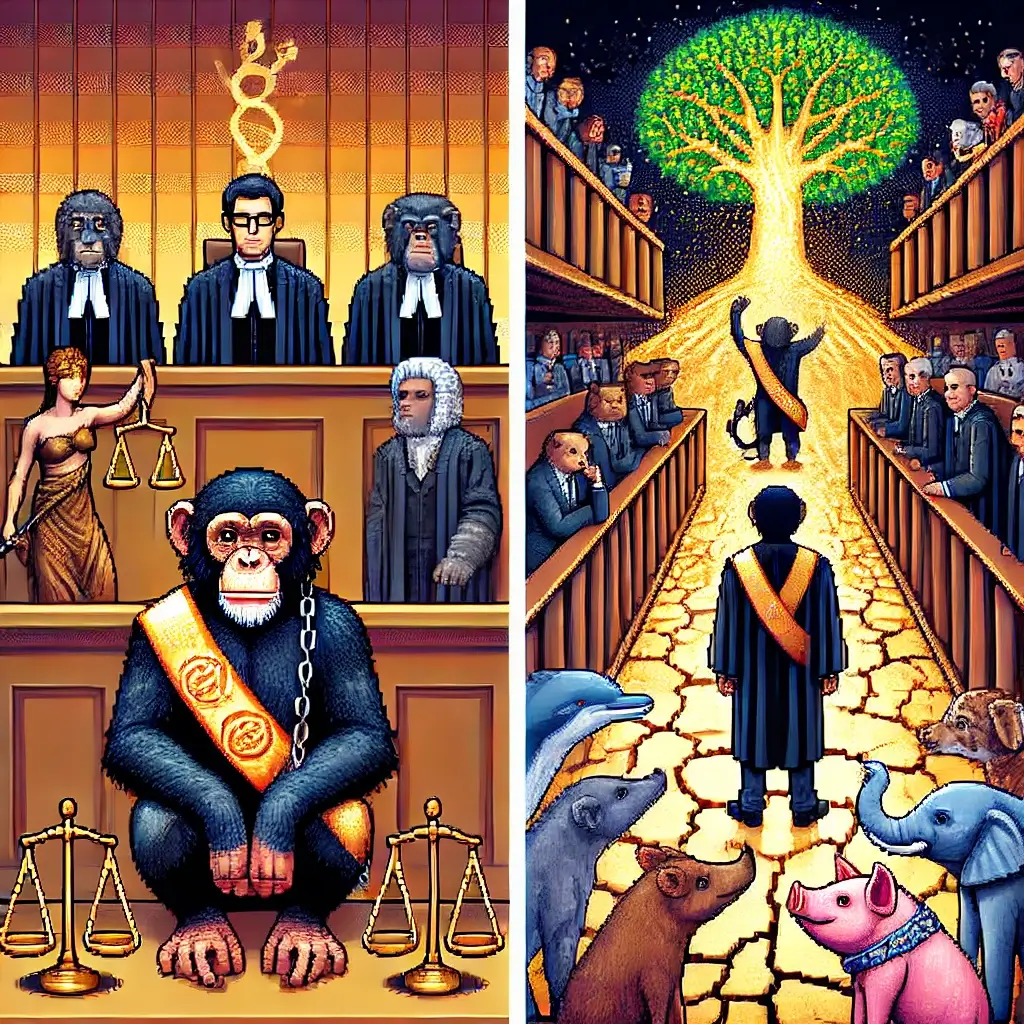
The Fight for Animal Rights: Why 3 Lives Were Forever Changed!
Ever stopped to think about the creatures we share this planet with?
I mean, really think about them?
Not just as pets or livestock, but as individuals with their own lives, their own desires, and, dare I say it, their own rights?
It’s a thought that, for a long time, was dismissed as pure fantasy, the ramblings of overly emotional animal lovers.
But let me tell you, times are changing, and the conversation around **animal rights** and **legal personhood** for animals is no longer just a whisper in the wind; it’s a roar that’s shaking legal systems worldwide. —
Table of Contents
—
The Awakening: From Property to Persons?
For centuries, the law has treated animals as nothing more than property.
Think of it like your car or your toaster – you own it, you can pretty much do what you want with it (within certain cruelty limits, thankfully).
But does that really sit right with you?
Especially when you look into the eyes of a dog who clearly understands what you’re saying, or a chimpanzee who can communicate using sign language?
This traditional view, while legally convenient, feels increasingly outdated and morally bankrupt to many.
The core of the debate, my friends, revolves around this idea of **legal personhood**.
No, we’re not talking about making your cat eligible to vote or pay taxes – though that would certainly spice up election cycles!
Instead, legal personhood, in this context, means granting animals certain fundamental rights, much like we do for human beings.
It means they would no longer be mere objects but entities with the capacity to be rights-holders.
Imagine, for a moment, a world where an animal couldn’t be subjected to cruel experiments without their “consent” (or at least, the consent of someone legally representing their interests).
A world where a circus couldn’t force an elephant to perform unnatural tricks because it violates her bodily autonomy.
Sounds radical, doesn’t it?
But the truth is, the line between what we consider a “person” and what we don’t is far blurrier than most people realize.
Historically, legal personhood has been extended to corporations, ships, and even rivers in some groundbreaking cases.
If a river can have rights, why not a being that can feel pain, joy, and fear?
It’s a question that’s getting harder and harder to ignore.
One of the driving forces behind this movement is the growing scientific understanding of animal sentience.
We’re learning more and more every day about the complex emotional and cognitive lives of animals.
Dolphins have culture.
Pigs can play video games.
Octopuses use tools and have individual personalities.
It’s no longer just anecdotal evidence from pet owners; it’s robust scientific inquiry showing that many animals are capable of far more than we ever gave them credit for.
This scientific revelation is directly challenging the legal framework that insists animals are simply unthinking, unfeeling automatons.
It’s creating a profound disconnect between what we know to be true about animals and how our legal systems treat them.
And that, my friends, is a recipe for revolution. —
The Hurdles We Face: Why Is This So Hard?
Now, I know what some of you might be thinking: “This all sounds lovely, but how on earth would it even work?”
And you’re right, it’s incredibly complex.
There are monumental challenges to overcome before we see widespread recognition of **animal rights** as legal persons.
One of the biggest obstacles is the sheer scale of our reliance on animals.
Our entire society, from our food systems to our pharmaceutical industries, is built on the premise that animals are resources for human use.
If we suddenly granted them rights that prevented their exploitation, the ripple effects would be enormous, potentially reshaping economies and lifestyles across the globe.
This isn’t just about changing a few laws; it’s about fundamentally re-evaluating our relationship with the natural world.
Another significant hurdle is the legal precedent.
Law, by its very nature, is conservative.
It relies heavily on what has come before.
To introduce an entirely new category of legal person – one that doesn’t fit neatly into existing boxes – requires a monumental shift in legal thinking.
Judges and lawmakers are trained to interpret existing laws, not necessarily to create entirely new paradigms, especially when those paradigms could have such far-reaching consequences.
It’s like trying to teach an old dog new tricks, but this dog is the entire legal system!
Then there’s the philosophical debate.
What criteria do we use to define “personhood”?
Consciousness? Self-awareness? The ability to reason?
Where do we draw the line?
And who gets to decide?
These aren’t easy questions, and brilliant minds have been grappling with them for centuries.
Some argue that only beings capable of abstract thought or moral reasoning can be considered persons.
Others argue that the capacity to suffer is enough to warrant legal protection.
These deeply held philosophical differences contribute to the slow pace of change.
It’s not just about what’s right; it’s about what we, as a society, are willing to accept as fundamental truth.
And let’s not forget the practicalities.
If animals have rights, who would enforce them?
Who would represent their interests in court?
Would we need a whole new branch of law dedicated to animal litigation?
These aren’t trivial concerns; they require careful thought and innovative solutions.
But the fact that these questions are being asked, and seriously debated, shows just how far we’ve come.
It indicates that the conversation is no longer about “if” but “how.”
—
Groundbreaking Cases: When Animals Stood Up in Court
Despite the immense challenges, there have been some truly revolutionary moments in the fight for **animal rights**.
These aren’t just legal theories; they’re real cases where real animals, or their advocates, have pushed the boundaries of what’s legally possible.
One of the most widely discussed cases involves **Happy the Elephant**.
Happy is an Asian elephant who has lived at the Bronx Zoo for decades, much of it in solitary confinement, which is deeply problematic for such social creatures.
The Nonhuman Rights Project (NhRP), a pioneering animal rights organization, filed a habeas corpus petition on Happy’s behalf, arguing that she is an autonomous, cognitively complex being who should be recognized as a legal person and released to an elephant sanctuary.
Now, habeas corpus is a legal writ typically used to challenge the unlawful detention of *humans*.
So, you can imagine the legal earthquake this created!
While New York’s highest court ultimately ruled against Happy in June 2022, stating that habeas corpus is “limited to human beings,” the case itself was a monumental step.
It forced the legal system to confront, head-on, the question of an animal’s right to liberty.
The arguments made, the dissenting opinions (yes, some judges agreed with Happy!), and the sheer public attention it garnered have irrevocably changed the conversation around elephant rights and legal personhood.
It wasn’t a win for Happy in the immediate sense, but it was a massive win for the movement as a whole.
Another fascinating saga involves **chimpanzees, specifically Tommy, Kiko, Hercules, and Leo**.
Again, the Nonhuman Rights Project was at the forefront.
They argued that these highly intelligent and self-aware chimpanzees, who were being held in captivity for research or entertainment, should be granted legal personhood and moved to sanctuaries.
These cases also utilized habeas corpus petitions, pushing courts in New York to consider whether the common law writ could apply to nonhuman animals.
While these initial cases also faced judicial resistance, they laid crucial groundwork.
The judges were forced to grapple with the scientific evidence of chimpanzee cognition and autonomy.
Even when the rulings were unfavorable, the very act of bringing these cases before the highest courts forced a public and legal reckoning with the property status of chimpanzees.
It was a slow, grinding battle, but each legal challenge chipped away at the old ways of thinking.
It’s like trying to move a mountain with a spoon, but with enough spoons and enough persistent diggers, even mountains can be moved.
It’s not just about individual animals, either.
There have been cases, particularly in Latin America, where courts have recognized the rights of nature itself, sometimes implicitly extending protections to the animals within those ecosystems.
For example, in Colombia, a court granted legal rights to the Atrato River, recognizing its ecosystem as an entity with rights to protection, conservation, maintenance, and restoration.
While not directly granting **legal personhood** to individual animals, such rulings represent a significant philosophical shift.
They move us away from a purely anthropocentric view of the world and toward one that recognizes the intrinsic value of other living systems and the beings within them.
These cases are like tiny cracks in a dam, and with enough pressure, those cracks can turn into a flood.
And let’s not forget the “sentient being” clauses appearing in legislation in various parts of the world.
Countries like New Zealand, for instance, have explicitly recognized animals as sentient beings in their Animal Welfare Act.
While this doesn’t grant them full legal personhood, it’s a critical step.
It legally acknowledges that animals can feel pain, distress, and pleasure, which provides a stronger basis for advocating against cruelty and exploitation.
These legislative changes are often influenced by the ongoing legal battles and the growing public awareness generated by high-profile cases.
It’s a testament to how advocacy, even when it faces initial setbacks, can ultimately shift the legal and societal landscape.
For more on these fascinating legal battles, you absolutely have to check out the Nonhuman Rights Project:
The Nonhuman Rights Project: A Force to Be Reckoned With
If you’re going to talk about **animal rights** and **legal personhood**, you simply cannot ignore the Nonhuman Rights Project (NhRP).
These folks are the real trailblazers, the legal eagles who are putting their money where their mouth is and taking these audacious claims directly to the courts.
Founded by attorney Steven Wise, the NhRP is the only civil rights organization in the United States working to achieve actual legal rights for nonhuman animals.
Their strategy is brilliant in its simplicity and audacious in its ambition: they use common law and scientific evidence to argue that certain animals – specifically those with complex cognitive abilities like great apes, elephants, and dolphins – should be recognized as legal persons with the fundamental right to bodily liberty.
Think about that for a second.
They’re not just asking for better welfare standards or stricter anti-cruelty laws.
They’re demanding a complete paradigm shift, asking judges to look at these animals not as things, but as sentient, autonomous beings deserving of fundamental legal protections.
It’s like they’re saying, “Hey, your Honor, these animals aren’t just property. They’re individuals, and they deserve to be treated as such!”
Their approach is rooted in the idea of **autonomy** and **self-determination**.
They argue that if an animal can demonstrate complex cognitive abilities, self-awareness, and the capacity to make choices, then they should not be held in conditions that deny their fundamental liberty.
This isn’t about giving a goldfish the right to vote; it’s about recognizing that a creature like an elephant or a chimpanzee has a rich inner life and a profound interest in not being confined or exploited.
Their work is meticulously researched and scientifically informed.
They bring in top experts in primatology, ethology, and cognitive science to present compelling evidence of animal minds.
They’re not just relying on emotional appeals (though, let’s be honest, who doesn’t feel something when they see an animal suffering?).
They’re building their cases on solid, scientific ground, which is exactly what’s needed to sway a cautious legal system.
It’s like building a skyscraper, brick by painstaking brick, and each brick is a scientific paper or a legal precedent.
The NhRP’s efforts have generated incredible global attention.
Even when they don’t win outright, their cases ignite public debate, educate people about animal sentience, and push the legal boundaries.
They force judges to write opinions grappling with these profound questions, which then become part of the legal record, influencing future cases and scholars.
They’re effectively sowing seeds of change in the stony soil of legal tradition.
They’re also incredibly strategic.
They target specific animals in specific jurisdictions where they believe they have the best chance of success, knowing that even one landmark victory could open the floodgates for others.
Their work is a testament to the power of persistent, well-argued advocacy.
If you want to dive deeper into their mission and groundbreaking work, definitely check out their official website:
What Does the Future Hold for Animal Rights?
So, where do we go from here?
The road ahead for **animal rights** and **legal personhood** is undoubtedly long and winding, but there are clear signs of progress that give advocates hope.
One major trend we’re seeing is the increasing public awareness and empathy for animals.
Social media, documentaries, and even news reports are making it harder for people to ignore the realities of animal exploitation.
When you see a heart-wrenching story about a mistreated animal, it resonates differently now.
People are demanding more, and that public pressure inevitably trickles up to lawmakers and legal institutions.
It’s like a slow, steady tide rising against the old walls of indifference.
We’re also likely to see more incremental legal changes that chip away at the “property” status of animals.
While full legal personhood might be a distant goal for many species, there’s a growing movement to grant animals specific rights or protections that acknowledge their sentience.
This could include things like stricter prohibitions on certain types of animal testing, mandatory enrichment for captive animals, or even specific legal standing for animal welfare organizations to sue on behalf of animals.
Think of it as building a bridge, not just a single, giant leap.
Each new regulation or recognition of sentience is a plank on that bridge, bringing us closer to a more just world for animals.
The scientific community will continue to play a crucial role.
As our understanding of animal cognition, emotion, and social structures deepens, it becomes harder and harder to deny their capacity for suffering and their interest in living a life free from pain and confinement.
Neuroscience, in particular, is revealing astonishing similarities between human and animal brains, reinforcing the argument that many animals experience the world in ways far more complex than previously imagined.
This ongoing scientific discovery is the fuel that powers the legal arguments for **legal personhood**.
It’s providing the irrefutable evidence that legal systems will eventually have to confront.
International developments will also be key.
We’ve already seen countries and regions like the European Union take significant steps towards recognizing animal sentience in their foundational laws.
These international benchmarks can influence legal reforms in other nations, creating a global ripple effect.
When one country takes a bold step, it often inspires others to follow suit, even if slowly.
It’s a global conversation, and every voice, every legal challenge, contributes to the chorus.
Finally, the dedicated work of organizations like the Nonhuman Rights Project will continue to be absolutely vital.
They are the ones bravely pushing the boundaries, filing those groundbreaking lawsuits, and forcing the courts to confront these uncomfortable but necessary questions.
Their persistence, even in the face of setbacks, is what keeps the momentum going.
The legal landscape for animals is not a static one; it’s a dynamic, evolving field, shaped by science, ethics, and the tireless efforts of advocates.
The future, while uncertain, is undeniably brighter for animals than it has ever been.
For a deeper dive into the legal scholarship and ongoing debates, consider exploring resources from organizations focused on animal law, such as the Animal Legal Defense Fund:
Your Role in This Revolution
You might be reading all of this and thinking, “Okay, this is huge, but what can I, just one person, possibly do?”
And you’d be surprised.
Every single one of us has a role to play in this ongoing revolution for **animal rights**.
First and foremost, **educate yourself**.
The more you understand about animal sentience, the legal arguments, and the ethical implications, the better equipped you’ll be to talk about it with others.
Knowledge is power, and in this case, it’s the power to challenge outdated notions and inspire change.
Read books, watch documentaries, follow organizations like the Nonhuman Rights Project and the Animal Legal Defense Fund.
Become a well-informed advocate, not just an emotional one.
Next, **speak up!**
Don’t be afraid to engage in conversations about animal welfare and rights, even if they’re uncomfortable.
Share articles, discuss the latest news, and challenge speciesist assumptions when you encounter them.
Your voice, combined with countless others, creates a ripple effect that can shift public opinion.
Every conversation is an opportunity to plant a seed of empathy and understanding.
Consider **supporting organizations** that are actively working on these issues.
Whether it’s through donations, volunteering, or simply sharing their work on social media, your support helps them continue their vital legal battles and advocacy efforts.
These organizations are on the front lines, fighting for those who cannot fight for themselves, and they rely on public support to do so.
They’re like the special forces of the animal rights movement!
And finally, **make conscious choices in your daily life**.
Every purchasing decision, every meal you choose, can have an impact.
Support companies with strong animal welfare policies.
Reduce your consumption of animal products if that aligns with your values.
Visit ethical sanctuaries instead of facilities that exploit animals for entertainment.
These individual choices, when multiplied by millions, create powerful market signals that can drive systemic change.
Remember, the fight for **animal rights** is not just a legal battle; it’s a moral imperative.
It’s about expanding our circle of compassion to include all sentient beings.
The history of human rights shows us that what once seemed impossible can, with persistence and dedication, become reality.
The same can, and must, be true for the animals we share this precious planet with.
The time for change is now, and your involvement matters more than you know.
To learn more about how you can get involved and stay informed, visit these valuable resources:
Animal Rights, Legal Personhood, Animal Welfare, Nonhuman Rights Project, Sentience