
Gig Economy Showdown: 5 Shocking Battles Over Worker Rights!
The Legal Tug-of-War Between Independent Contractors and Employees – Who Wins?
The Wild West of the Gig Economy: A Personal Anecdote
Alright, folks, let’s get real for a second. If you’re reading this, chances are you’ve either been a gig worker, hired one, or at least ordered takeout from an app. The gig economy? It’s everywhere, isn’t it?
I remember a few years back, I was dabbling in some freelance writing gigs myself. One minute I was my own boss, setting my hours, feeling like a true independent spirit, sipping coffee in my pajamas. The next, I was getting constant notifications, tight deadlines, and detailed instructions that made me feel more like… well, an employee, just without the benefits or job security.
It felt like walking a tightrope. On one side, the freedom. On the other, the nagging feeling that I was giving up a lot of traditional protections. And believe me, that feeling is at the heart of one of the biggest, most explosive legal battles of our time: the **Gig Economy Worker Classification Disputes**.
It’s not just a dry legal topic, folks. This is about real people, real livelihoods, and literally billions of dollars at stake. It’s about whether that delivery driver zooming past you gets minimum wage, overtime, and maybe even health insurance. Or if they’re truly “their own boss” and entirely on their own when things go sideways.
Why Does This Classification Battle Even Matter? It’s Not Just About Titles!
You might be thinking, “Who cares if someone’s called an independent contractor or an employee? A job’s a job, right?” Oh, if only it were that simple! The distinction between an independent contractor and an employee is like night and day in the eyes of the law, especially when it comes to labor protections.
Think about it. If you’re an employee, you’re generally entitled to a whole host of things:
Minimum Wage: No matter how slow business is, your employer has to pay you at least the legal minimum.
Overtime Pay: Worked more than 40 hours in a week? Cha-ching! Overtime pay for those extra hours.
Workers’ Compensation: Got injured on the job? Your medical bills and lost wages might be covered.
Unemployment Insurance: Laid off? You might be able to collect unemployment benefits to help you stay afloat.
Anti-Discrimination Laws: Protected from discrimination based on race, gender, age, religion, and more.
Health Benefits, Retirement Plans, Paid Time Off: While not always legally mandated, these are common employee perks.
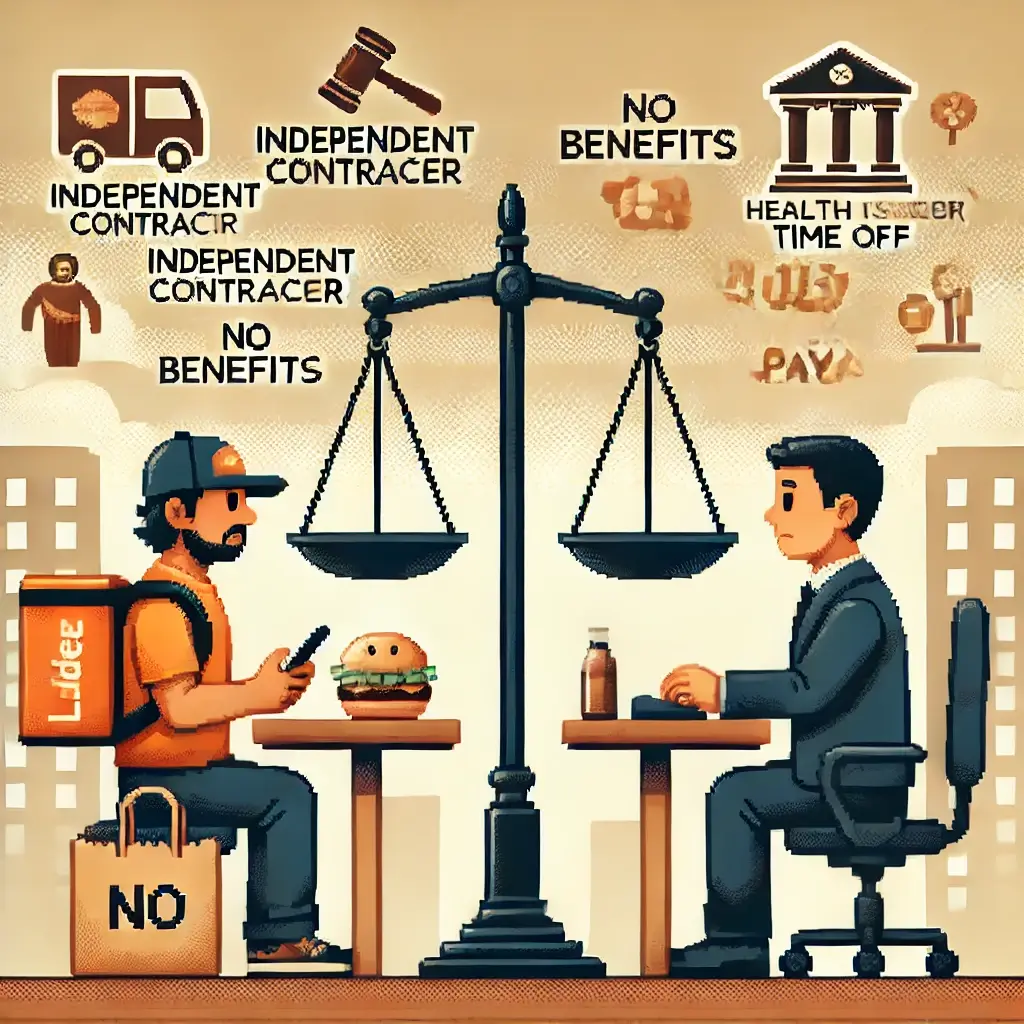
Now, flip the coin. If you’re an independent contractor, guess what? You get *none* of that. You’re essentially running your own mini-business. You cover your own expenses, pay self-employment taxes (which are higher!), don’t get overtime, and if you get hurt on the job, you’re usually out of luck unless you have your own private insurance.
For companies, classifying workers as independent contractors is a massive cost-saver. No payroll taxes, no benefits, no overtime, less administrative hassle. It’s an attractive model for fast-growing businesses that want flexibility and lower overheads. But for workers, it often means sacrificing fundamental protections for the sake of flexibility – a flexibility that, frankly, is often dictated by the platform anyway.
This isn’t just about semantics; it’s about fairness, economic security, and who bears the risk in the burgeoning **gig economy**.
The Nitty-Gritty: How Do Courts Actually Decide? (Spoiler: It’s Complicated!)
So, if there’s such a huge difference, how do courts figure out who’s who? There isn’t one magic bullet, unfortunately. Different states and even different federal agencies use slightly different tests, but they all boil down to one core question: How much control does the company have over the worker?
Think of it like this: if you’re painting your house, and you hire a contractor, they tell *you* when they’ll paint, what kind of paint they’ll use, and generally how they’ll get the job done. You just care about the finished product. That’s a contractor.
But if you’re a manager at a store, your boss tells you when to show up, what tasks to do, how to do them, and even what to wear. That’s an employee.
The “control” test isn’t just about direct supervision. It looks at a bunch of factors, often called the “economic realities” test or the “ABC test.” Here’s a simplified rundown of what courts consider, though it varies wildly:
1. Behavioral Control: Does the company direct or control how the worker performs the task? This is the big one. Think about training, instructions, evaluation methods, and tools provided. If a gig app dictates your route, tells you what to say to customers, or gives you a rating that impacts future work, that points towards employee status.
2. Financial Control: Does the company control the business aspects of the worker’s job? This includes how the worker is paid, whether expenses are reimbursed, who provides tools and supplies, and whether the worker can seek out other business opportunities. If a gig worker has little ability to negotiate rates, must use the company’s equipment, or is prohibited from working for competitors, it leans towards employment.
3. Type of Relationship: Are there written contracts describing the relationship? Does the worker receive benefits? Is the relationship expected to continue indefinitely? Are the services performed a key aspect of the company’s regular business? If a company hires hundreds or thousands of “contractors” to perform its core service, like driving or delivering food, it starts to look less like an arms-length contractor relationship and more like an employer-employee dynamic.
The challenge with the **gig economy** is that it blurs these lines. Companies often claim they’re just “platforms” connecting customers with independent service providers. But courts and regulators are increasingly looking past the labels to the actual reality of the work.
The Top 5 High-Profile Gig Economy Classification Cases You NEED to Know!
These aren’t just obscure legal footnotes; these are the cases that have sent shockwaves through boardrooms and drivers’ seats across the globe. Each one highlights the intense legal battles over **gig economy worker classification**.
1. Uber’s California Conundrum: Prop 22 and the AB5 Aftermath
Ah, Uber. The poster child of the gig economy. For years, they’ve fiercely defended their drivers’ independent contractor status. In California, this battle reached a fever pitch with the passage of Assembly Bill 5 (AB5) in 2019.
AB5 essentially codified the “ABC test” into law, making it much harder for companies to classify workers as independent contractors. Suddenly, companies like Uber and Lyft were facing the prospect of reclassifying thousands of drivers as employees, which would cost them billions.
Their response? They poured over $200 million into a ballot initiative called Proposition 22 (Prop 22). This proposition sought to exempt app-based transportation and delivery companies from AB5, allowing them to continue classifying drivers as independent contractors while providing some limited benefits (like a minimum earnings guarantee and healthcare stipends). It passed in November 2020, but it wasn’t the end of the story.
A California superior court actually ruled Prop 22 unconstitutional in 2021, stating it infringed on the legislature’s power to regulate workers’ compensation. However, the ruling was overturned on appeal in 2023, and the California Supreme Court declined to review the appeal in 2024, leaving Prop 22 in effect for now. This rollercoaster perfectly illustrates the volatility and massive financial stakes involved in **gig economy** disputes. It’s like watching a legal thriller unfold in real-time!
Want to dig deeper into Prop 22? Check out this resource:
2. Dynamex Operations West, Inc. v. Superior Court (California, 2018)
Before AB5, there was Dynamex. This California Supreme Court case was a game-changer. It established the “ABC test” as the default for determining independent contractor status under California wage orders. This test is notoriously difficult for companies to pass if they want to classify workers as contractors:
A. The worker is free from the control and direction of the hiring entity in connection with the performance of the work, both under the contract for the performance of the work and in fact.
B. The worker performs work that is outside the usual course of the hiring entity’s business.
C. The worker is customarily engaged in an independently established trade, occupation, or business of the same nature as the work performed for the hiring entity.
The “B” prong is particularly tricky for **gig economy** companies. If your primary business is delivering food, and your drivers deliver food, how can they be “outside the usual course of your business”? This ruling sent shivers down the spines of many gig companies and laid the groundwork for AB5.
3. The UK Supreme Court and Uber (2021)
It’s not just a U.S. thing! In 2021, the UK Supreme Court delivered a landmark ruling against Uber, finding that its drivers were “workers” (a classification distinct from “employees” but with more rights than independent contractors) entitled to minimum wage and paid holidays. This was a huge win for drivers who had been fighting for years.
The court essentially looked at the reality of the situation: Uber set the fares, dictated routes, and had significant control over the drivers, even penalizing them for declining too many rides. This decision forced Uber to change its operating model in the UK, offering guaranteed minimum wage and holiday pay. It was a clear signal that courts are willing to look past clever contractual language to the actual working relationship in the **gig economy**.
Curious about the UK Supreme Court’s reasoning? Take a look:
Read the UK Supreme Court Judgment
4. Amazon Flex Drivers’ Arbitration Woes (Various Cases)
While not a single landmark court case, Amazon Flex drivers have been at the center of numerous arbitration proceedings and class-action lawsuits regarding their independent contractor status. Amazon, like many **gig economy** giants, relies heavily on arbitration clauses in their agreements, forcing disputes out of public courts and into private arbitration.
However, many arbitrators have still found in favor of drivers, concluding they were misclassified. These cases highlight a different front in the classification wars: the battle over where these disputes are heard. Even if not making headlines like Supreme Court decisions, the sheer volume of these cases indicates a widespread issue within the **gig economy** model.
5. Grubhub/DoorDash Lawsuits (Ongoing)
It’s not just Uber. Food delivery services like Grubhub and DoorDash have also faced their fair share of legal challenges. Many of these cases mirror the arguments made against ride-sharing companies, focusing on the level of control the platforms exert over their drivers – from how orders are assigned to how quickly they must be delivered, and even what insulated bags they should use.
These ongoing legal battles often result in large settlements, but rarely a definitive nationwide ruling, leading to a constant game of whack-a-mole for these companies as they navigate different state laws and court interpretations of **gig economy worker classification**.
The U.S. Landscape: A Patchwork of Laws and Landmark Shifts
Navigating the legal landscape in the United States regarding **gig economy worker classification** is like trying to cross a river on a series of slippery stones – one wrong step, and you’re in hot water. Unlike some countries with more unified labor laws, the U.S. operates under a complex system of federal and state regulations, often leading to conflicting outcomes.
At the federal level, agencies like the Department of Labor (DOL) and the Internal Revenue Service (IRS) have their own tests. The DOL primarily uses the “economic realities” test to determine if a worker is “economically dependent” on the employer, leaning towards employee status. The IRS, on the other hand, focuses on three main categories: behavioral control, financial control, and the type of relationship. Historically, the IRS test has been seen as a bit more flexible, making it easier to classify workers as independent contractors.
But here’s where it gets really interesting: the states. California, with its AB5 law (influenced by the Dynamex decision), is a prime example of a state taking an aggressive stance. AB5 presumes workers are employees unless they can meet all three prongs of the strict “ABC test.” This has caused massive headaches for **gig economy** companies operating there, leading to the aforementioned Prop 22 battle.
However, not all states have followed California’s lead. Many still rely on more traditional, multi-factor tests that give companies more leeway. This creates a fascinating, albeit chaotic, situation where a gig company might classify workers differently depending on which state they operate in. Imagine the compliance nightmare!
We’re also seeing shifts at the federal level. The Biden administration, through the DOL, has generally signaled a preference for classifying more workers as employees, aligning with a pro-worker stance. They’ve proposed rules that would codify an “economic realities” test, making it harder for companies to misclassify workers as independent contractors. These proposed rules are often met with fierce lobbying from **gig economy** companies, setting the stage for future legal and political battles.
The takeaway? The U.S. remains a battleground for **gig economy worker classification**. It’s a dynamic, ever-changing environment where companies, workers, and lawmakers are constantly pushing and pulling, trying to find a balance between innovation, flexibility, and worker protection. It’s a dance as old as capitalism itself, just with new tech-enabled steps.
Beyond Borders: How Other Countries Are Tackling the Gig Economy Conundrum
If you think the U.S. situation is a messy tangle, just wait until you see how other countries are grappling with the **gig economy worker classification** dilemma! While the fundamental issues are the same – control, risk, and benefits – the approaches vary wildly, offering some fascinating insights and potential roadmaps for the future.
The European Union’s Directive: A Game Changer?
The European Union (EU) is perhaps taking the most ambitious approach. In 2021, the European Commission proposed a directive on platform work that aims to establish a legal presumption of employment for gig workers if certain criteria are met. This means the burden would be on the platforms to prove that their workers are *not* employees, rather than on the workers to prove they are.
The proposed directive looks at factors like whether the platform actively sets or caps payment, supervises performance electronically, restricts worker freedom to choose hours, or prevents workers from building a client base. If two out of five such criteria are met, the worker would be presumed to be an employee. This is a big deal, as it could force a massive reclassification of millions of **gig economy** workers across all 27 EU member states, granting them access to minimum wage, collective bargaining rights, social protection, and more.
It’s not finalized yet, and there’s a lot of debate among member states, but if passed, this could set a global precedent for how tech platforms operate. It’s a truly proactive step to ensure fair working conditions in the **gig economy**.
Spain’s “Riders’ Law”: Direct Action
Spain is one of the few countries that has already implemented a specific law targeting the classification of delivery riders. Known as the “Riders’ Law,” it came into effect in 2021 and explicitly presumes that food delivery riders working through digital platforms are employees, not independent contractors. This means companies like Glovo and Deliveroo had to reclassify thousands of their riders, providing them with employee benefits and protections.
This law was a direct response to court rulings and public pressure, showcasing a legislative willingness to step in and define the terms of **gig economy** employment. It’s a bold move that has certainly caused a stir, but it reflects a growing global sentiment that platforms must take more responsibility for their workforce.
Australia’s Fair Work Act and Gig Economy Inquiries
Australia has also been actively debating the issue. While there isn’t a sweeping “ABC test” or a Riders’ Law, the Fair Work Commission (FWC), Australia’s industrial tribunal, has increasingly sided with workers in specific cases, finding that some gig workers were, in fact, employees. There have also been numerous inquiries and proposals for legislative reform to address the unique challenges of the **gig economy**, focusing on ensuring minimum standards and protections for platform workers.
These examples illustrate a global trend: governments and courts are increasingly scrutinizing the independent contractor model in the **gig economy**. The era of platforms simply calling everyone an “independent contractor” and washing their hands of worker responsibilities seems to be drawing to a close, albeit slowly and with significant resistance.
For more on global trends in gig worker classification, check out this article:
The Crystal Ball: What Does the Future Hold for Gig Workers?
Peering into the future of the **gig economy** and worker classification is a bit like trying to predict the weather in a hurricane – it’s volatile, unpredictable, and constantly shifting. However, we can spot some strong winds that are likely to shape the landscape in the coming years.
More Legislation, More Nuance?
It’s highly probable that we’ll see more legislative action, both at the state and federal levels in the U.S., and across other countries. The current patchwork of laws is unsustainable and creates immense uncertainty for both workers and companies. We might see a move towards a “third way” – a hybrid classification that offers some protections to gig workers without forcing them into a full employee model. Think of it as a middle ground, a “worker plus” category, where they get some benefits like minimum earnings, accident insurance, and collective bargaining rights, but retain some flexibility.
This “third way” is already being explored in some regions. It aims to bridge the gap between the desire for flexibility and the need for basic labor protections, addressing the core issues in **gig economy worker classification** without completely upending the business model.
Technological Solutions and AI’s Role
As the legal landscape evolves, so too will the technology. Companies might leverage AI and algorithms to better manage their workforce within legal boundaries. For instance, if an algorithm is designed to ensure workers genuinely have control over their hours and earnings, it might bolster an independent contractor argument. Conversely, if AI is used to exert more granular control, it will strengthen the case for employee status.
We could also see new platforms emerge that are specifically designed to adhere to employee models from the outset, or even worker-owned cooperatives that bypass the traditional employer-employee structure altogether, giving workers more direct control and ownership.
Increased Unionization and Collective Bargaining
As legal battles rage on, many gig workers are realizing the power of collective action. We’re already seeing nascent efforts at unionization and collective bargaining among drivers and delivery riders. Even if they are classified as independent contractors, forming associations or unions can give them a stronger voice to negotiate better terms, pay, and conditions with the platforms.
This is a significant trend because it shifts some of the power dynamics. Instead of individual workers trying to challenge giant corporations, they can unite, making their demands much harder to ignore. This push for collective bargaining is a powerful force that will continue to shape the future of **gig economy worker classification**.
Ultimately, the future likely holds a more regulated, more balanced **gig economy**. The initial “wild west” phase, where anything went, is slowly but surely coming to an end. It won’t be a uniform outcome globally, but the direction of travel seems clear: greater protections for gig workers are on the horizon, one way or another.
My Two Cents: Advice for Gig Workers and Companies Alike
Alright, so after all that legal talk and crystal ball gazing, what’s the practical takeaway? If you’re a gig worker or a company utilizing gig workers, what should you actually *do*?
For Gig Workers: Be Informed, Be Prepared!
1. Know Your Rights (or Lack Thereof): Understand that as an independent contractor, you’re responsible for your own taxes (including self-employment tax!), benefits, and insurance. Don’t assume anything. Look up the specific laws in your state or country regarding **gig economy worker classification**.
2. Track Everything: Keep meticulous records of your hours, earnings, expenses, and any communications with the platform. This data can be invaluable if you ever need to challenge your classification or apply for benefits.
3. Diversify Your Income (If Possible): Don’t put all your eggs in one gig basket. Working for multiple platforms or clients can strengthen your argument that you are an independent business owner, not solely dependent on one company. Plus, it’s just good financial sense!
4. Consider Collective Action: If you feel you’re being exploited or misclassified, connect with other workers. There’s strength in numbers, and collective advocacy groups are often at the forefront of these legal battles. Sites like the National Association of Worker Cooperatives (while not specifically gig-focused, they promote worker power) or labor rights organizations can be great resources.
5. Consult an Attorney: If you believe you’ve been misclassified or are owed back wages, don’t hesitate to seek legal advice. Many employment lawyers offer free initial consultations.
For Companies: Adapt or Be Left Behind!
1. Review Your Classification Practices Regularly: Don’t just set it and forget it. Labor laws, especially concerning the **gig economy**, are evolving rapidly. Work with legal counsel to ensure your classification practices align with current federal, state, and local regulations. A proactive approach can save you millions in penalties and legal fees down the line.
2. Understand the “Control” Factors: If you want to maintain an independent contractor model, genuinely cede control where possible. Give workers more autonomy over their schedules, methods, and even pricing. Avoid micro-managing or imposing employee-like requirements.
3. Budget for Potential Reclassification: Even if you’re confident in your current model, have a contingency plan. The legal landscape can change overnight. Factor in the potential costs of payroll taxes, benefits, and administrative overhead if a significant portion of your workforce were to be reclassified.
4. Explore Hybrid Models: The “third way” or “worker plus” model might be a viable path. Providing some voluntary benefits or guaranteed minimum earnings could mitigate legal risk and improve worker satisfaction, potentially deterring costly lawsuits. Think about what a truly sustainable **gig economy** looks like for your business.
5. Engage in Policy Discussions: Don’t just react; participate. Engage with lawmakers and advocacy groups to help shape future legislation in a way that balances business innovation with worker protections. Your voice matters in shaping the future of the **gig economy**.
The bottom line for both sides: this isn’t just a fleeting trend. The **gig economy** is here to stay, but its legal framework is still very much under construction. Ignoring the seismic shifts in worker classification is like ignoring a tsunami warning – it’s going to hit, and it’s better to be prepared than to be swamped.
Wrapping It Up: A Human-Centric Gig Economy?
So, there you have it: a deep dive into the fascinating, frustrating, and incredibly important world of **gig economy worker classification disputes**. From the streets of California to the courts of London, the battle lines are drawn, and the stakes couldn’t be higher. It’s a clash between innovation and regulation, flexibility and protection, profit and people.
Ultimately, these legal battles aren’t just about labels on a contract. They’re about dignity, security, and ensuring that the incredible growth of the **gig economy** doesn’t come at the expense of the very people who power it. As consumers, we’ve come to rely on the convenience of these services. As a society, we have a responsibility to ensure that this convenience is built on a foundation of fairness.
It’s a complex puzzle, no doubt. But with continued advocacy from workers, thoughtful legislation from governments, and a willingness from companies to adapt and evolve, we can hopefully move towards a future where the **gig economy** truly offers opportunity and flexibility, without sacrificing fundamental human rights and protections. It’s a tall order, but I’m optimistic that we’ll get there, one legal battle and legislative step at a time.
Gig Economy, Worker Classification, Legal Battles, Independent Contractors, Employee Rights