Biohacking’s Wild West: 3 Legal Minefields You MUST Know!
Alright, buckle up, fellow explorers of the human condition!
Today, we’re diving headfirst into a topic that’s as thrilling as it is terrifying: **biohacking**.
We’re talking about DIY medical devices and genetic self-modification – the stuff of science fiction that’s rapidly becoming science fact.
It’s a world where individuals are taking health and human enhancement into their own hands, often outside the traditional medical establishment.
And let me tell you, it’s not just about silicon implants under the skin for payment or NFC access anymore.
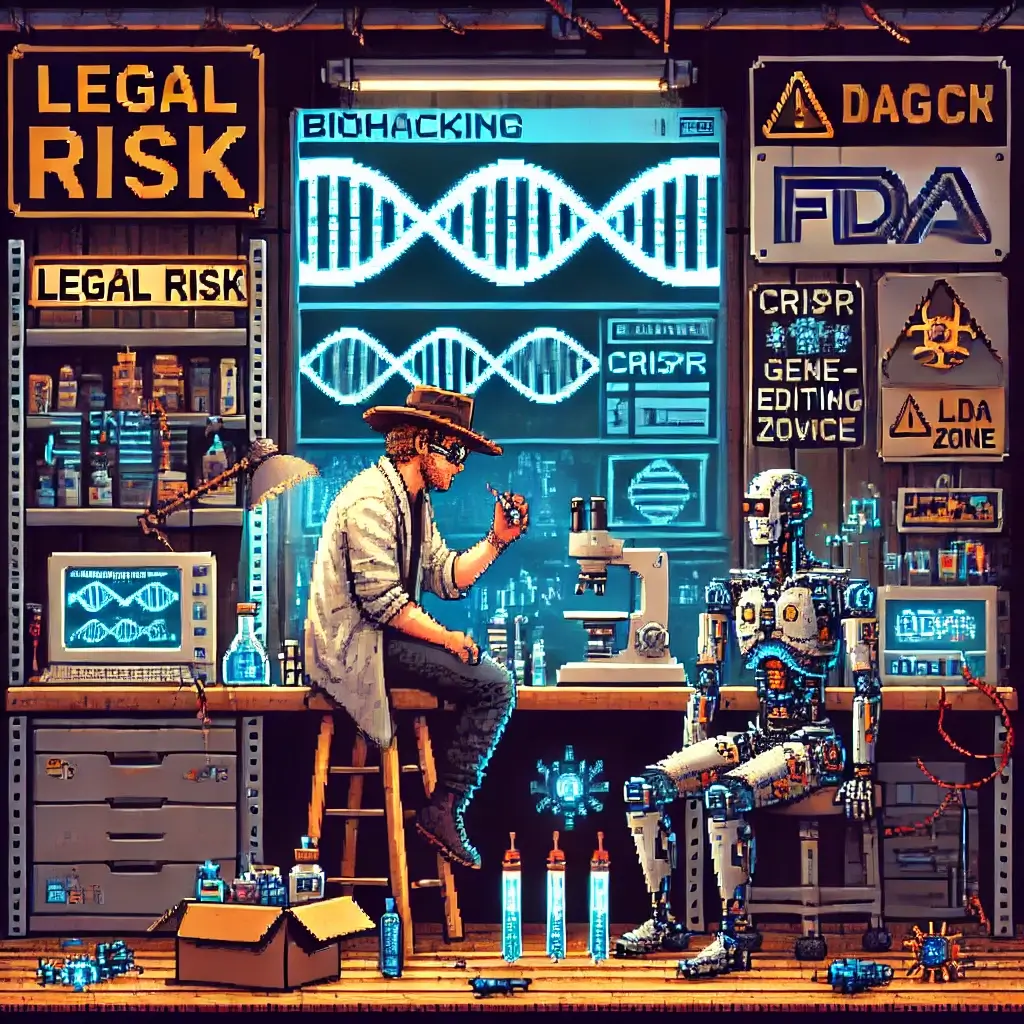
Oh no, we’re talking about people experimenting with CRISPR gene-editing tools in their garages, trying to cure their own diseases, or even, dare I say, enhance their natural abilities.
Sounds like something out of a cyberpunk novel, right?
Well, it is, and it’s happening right now, blurring the lines between patient, scientist, and innovator.
The allure is undeniable: imagine being able to fix a debilitating genetic condition without waiting for years of clinical trials, or giving yourself an edge in a world that demands more and more from us.
It’s the ultimate expression of personal autonomy, a rebellion against the slow, often bureaucratic pace of conventional medicine.
But here’s the kicker, folks – with great power comes… well, you know the rest.
This burgeoning field is a veritable legal minefield, largely unregulated and fraught with ethical dilemmas.
It’s like building a rocket in your backyard – sure, you might reach the moon, but you could also blow up your entire neighborhood.
And that’s why we need to talk about it, openly and honestly, before someone gets seriously hurt or, worse, sets a precedent that stifles innovation for everyone.
We’re going to explore **3** critical legal frameworks that are struggling to keep up with the rapid advancements in biohacking.
These aren’t just abstract legal concepts; they’re the invisible tripwires that could land you in hot water, or worse, put your health at severe risk.
Trust me, as someone who’s seen the good, the bad, and the downright reckless side of this movement, understanding these legalities isn’t just smart – it’s absolutely essential.
So, grab your favorite brain-boosting nootropic (kidding, mostly!), and let’s dive into the fascinating, frightening world of biohacking and its legal tightrope walk.
—Table of Contents
- Introduction to Biohacking and Its Legal Quandaries
- The Wild West of DIY Medical Devices: Regulation or Anarchy?
- CRISPR in the Garage: Genetic Self-Modification and the Law
- Liability and Accountability: When Biohacking Goes Wrong
- The Future of Biohacking and Regulation: A Delicate Balance
- Conclusion: Navigate the Biohacking Frontier Safely
Introduction to Biohacking and Its Legal Quandaries
Imagine a world where you’re not just a passive recipient of healthcare, but an active participant, even an architect, of your own biology.
That’s the promise, and the peril, of biohacking.
At its core, biohacking is about optimizing human performance and well-being through unconventional means, often leveraging cutting-edge science and technology.
It ranges from the relatively benign – like optimizing your sleep with blue light-blocking glasses or tracking your glucose levels – to the truly radical, such as implanting microchips or attempting gene therapy at home.
The allure is powerful.
For many, it’s about empowerment, taking control of their health in ways that traditional medicine often falls short.
It’s about pushing the boundaries of what’s possible, about being an early adopter in the grand experiment of human evolution.
Think of the early days of personal computing; a bunch of enthusiasts tinkering in their garages, building machines that would eventually revolutionize the world.
Biohacking, in some ways, feels like that.
There’s a vibrant, passionate community of individuals, often driven by a genuine desire to improve their lives or even find cures for conditions that mainstream medicine hasn’t adequately addressed.
However, unlike tinkering with code or electronics, tinkering with your own biology carries inherently higher risks.
You can’t just hit ‘undo’ if something goes wrong with a genetic modification.
The stakes are, quite literally, life and death.
And this is where the legal system, designed for a slower-paced, more traditional medical landscape, finds itself playing catch-up.
The existing frameworks for medical devices and pharmaceuticals are incredibly robust, but they’re built around the assumption of professional manufacturers, controlled environments, and rigorous testing.
Biohacking, by its very nature, often bypasses these structures.
So, how do you regulate something that’s being done in a bedroom lab, with materials bought online, and applied to one’s own body?
It’s a perplexing question, and one that has lawmakers, ethicists, and even the biohacking community itself scratching their heads.
The tension lies between individual freedom and public safety.
Do we have the right to do whatever we want with our bodies, even if it carries significant risks?
And at what point does a DIY health experiment become a public health concern?
These aren’t easy questions, and there are no simple answers.
But understanding the current legal landscape is the first step in navigating this brave new world safely and responsibly.
—The Wild West of DIY Medical Devices: Regulation or Anarchy?
Let’s kick things off by talking about **DIY medical devices**.
Now, when you hear “medical device,” you probably picture something sleek and sterile, produced by a huge corporation, right?
Think pacemakers, insulin pumps, MRI machines.
These are all subject to incredibly strict regulations, like those from the **U.S. Food and Drug Administration (FDA)**.
The FDA has a whole labyrinth of rules and pathways for getting a medical device approved, ensuring it’s both safe and effective.
It’s a lengthy, expensive process, and for good reason – you don’t want a faulty device inside someone’s body.
But what happens when someone decides to build their own medical device?
Or modify an existing one?
This is where things get murky, fast.
We’ve seen everything from homemade glucose monitoring systems to DIY nerve stimulation devices and even open-source prosthetic limbs.
On one hand, this innovation is incredible!
It can democratize access to vital health tools, especially for those who can’t afford commercial options or who have unique needs not met by mass-produced devices.
It’s the spirit of ingenuity that has driven so much progress.
Imagine a parent building a custom device for their child with a rare condition, something no big company would ever invest in.
That’s a heartwarming story, right?
But here’s the cold, hard truth: these DIY creations, however well-intentioned, bypass all the safety nets.
There’s no pre-market approval, no quality control, no standardized testing.
The materials might be toxic, the electronics might fail, or the design might cause more harm than good.
A perfect example of this dilemma is the “do-it-yourself pancreas” movement, where individuals with type 1 diabetes create their own closed-loop insulin delivery systems using off-the-shelf components and open-source software.
For many, these systems have been life-changing, offering better blood glucose control than commercially available devices.
They’ve literally saved lives.
Yet, from a legal standpoint, they exist in a grey area.
Are these individuals “manufacturers” subject to FDA regulation?
What about the developers of the open-source software?
Generally, if you’re making a device for your *personal use* and not for sale, you’re less likely to fall under strict regulatory scrutiny.
However, if you start sharing designs, distributing components, or worse, *selling* these devices, you quickly enter a hazardous legal landscape.
The FDA, for example, defines a “device” broadly and has the authority to regulate products intended for use in the diagnosis, cure, mitigation, treatment, or prevention of disease.
If your DIY creation fits this description, even if you call it an “experiment,” you could be treading on thin ice.
The legal frameworks simply weren’t designed for a world where everyone has a 3D printer and access to advanced electronics.
It’s a fascinating dance between public safety and individual autonomy.
And believe me, policymakers are still figuring out the choreography.
So, if you’re thinking of building your own health tech, ask yourself: Am I just tinkering for fun, or am I creating something that could genuinely impact someone’s health?
The answer determines whether you’re a hobbyist or, potentially, a rogue medical device manufacturer in the eyes of the law.
It’s a fine line, and often, only crossed when something goes wrong.
For more information on medical device regulations, you can check out the FDA’s official website:
Another great resource to understand the complexities of regulatory oversight in this area is the World Health Organization (WHO):
—CRISPR in the Garage: Genetic Self-Modification and the Law
Now, let’s venture into what I consider the most mind-blowing and ethically fraught area of biohacking: **genetic self-modification**.
This isn’t just about sticking a chip under your skin; this is about altering the very blueprint of life – your DNA.
The poster child for this revolution is CRISPR-Cas9, a gene-editing tool that has taken the scientific world by storm.
It’s relatively cheap, remarkably precise, and astonishingly easy to use, even for someone with a basic understanding of molecular biology.
And that, my friends, is both its greatest promise and its most terrifying threat.
Historically, genetic modification has been the exclusive domain of highly specialized labs, regulated by layers of oversight.
But with “DIY CRISPR kits” available online, anyone can theoretically order the components and start experimenting.
Yes, you heard that right.
You can, with relative ease, buy the ingredients to perform gene editing at your kitchen table.
This isn’t just theoretical; we’ve seen instances of individuals publicly attempting self-experimentation with gene therapies, claiming to be trying to cure their own illnesses, such as HIV or even aiming for muscle enhancement.
The problem?
The human body is an incredibly complex system, and DNA is its operating system.
One wrong “edit,” one off-target effect, and you could trigger unforeseen health consequences, from autoimmune diseases to cancer, or even pass unintended genetic changes to future generations.
It’s not like debugging a computer program where a crash just means a reboot.
Here, a “crash” could mean irreversible damage to your health, or worse.
So, what do the laws say about this?
Well, this is where it gets truly wild.
In many jurisdictions, there aren’t specific laws *prohibiting* self-experimentation with genetic modification, especially if you’re not selling anything or treating others.
It falls into a kind of legal void.
However, that doesn’t mean it’s safe or without legal ramifications.
If you’re buying biological materials or reagents, you might run afoul of regulations governing the transfer or acquisition of biological agents, especially if they could be deemed hazardous.
And if you cause harm to yourself or others (indirectly, perhaps by encouraging others to follow suit without proper safety protocols), the lines of liability become incredibly blurred.
For instance, while the FDA doesn’t directly regulate what you do to your own body in private, it *does* regulate gene therapy products.
If a “DIY kit” is marketed with claims that it can modify your genes for therapeutic purposes, it could be considered an unapproved drug or biological product, and thus illegal to sell or distribute.
This is precisely why companies selling these kits often market them as “research tools” or for “educational purposes only,” hoping to sidestep regulatory oversight.
It’s a clever, but deeply worrying, workaround.
The ethical implications are staggering, too.
What if someone tries to genetically enhance their child?
Or tries to create a “designer baby”?
These are not far-fetched scenarios in a world with readily available gene-editing tools.
Governments worldwide are grappling with this.
Some, like the UK, have stricter regulations on genetic manipulation.
Others are still figuring out how to even define “genetic self-modification” in a legal context.
It’s a race against time, and technology is winning.
If you’re even remotely curious about the legal and ethical tightrope of gene editing, I highly recommend checking out resources from reputable scientific organizations.
The National Institutes of Health (NIH) offers excellent insights into gene therapy and its ethical considerations:
Another organization deeply involved in these discussions is the Nuffield Council on Bioethics, particularly their work on gene editing:
Nuffield Council on Gene Editing
—Liability and Accountability: When Biohacking Goes Wrong
So, we’ve talked about the devices and the gene editing.
Now, let’s get down to the brass tacks of what happens when things inevitably, tragically, go wrong.
Because they do.
When you’re dealing with unregulated devices or untested biological modifications, the risk of adverse outcomes isn’t just theoretical; it’s a very real possibility.
And in the world of biohacking, figuring out who’s **liable** when something goes south is a Gordian knot of legal complexity.
In traditional medicine, if a faulty medical device harms a patient, the manufacturer can be sued for product liability.
If a doctor performs a procedure negligently, they can face malpractice claims.
There’s a clear chain of accountability.
But what if you’re the manufacturer, the doctor, and the patient all rolled into one?
If you injure yourself with a DIY device or a self-administered gene therapy, who do you sue?
Your past self, perhaps?
It’s a rhetorical question, of course, but it highlights the profound lack of legal recourse when things go wrong in a purely self-directed biohacking scenario.
This is especially pertinent when considering health insurance.
Will your health insurance cover the costs of repairing damage caused by an unregulated biohack?
Highly unlikely.
Most insurance policies have clauses that exclude coverage for experimental treatments or self-inflicted injuries.
You could be looking at crippling medical bills, all because you tried to “optimize” yourself.
What if you’re not just experimenting on yourself, but sharing your methods, encouraging others, or even providing materials?
This is where the legal risks multiply exponentially.
If someone else is harmed by following your unproven advice or using materials you provided, you could potentially face charges ranging from practicing medicine without a license to reckless endangerment, depending on the jurisdiction and the specifics of the harm caused.
Think about it: if I tell you to jump off a bridge, and you do, I might not be legally liable.
But if I build a faulty bridge and invite you to walk across it, that’s a whole different ballgame.
The legal system struggles with the “information versus product” distinction here.
Is a forum post describing a biohack just information, or is it a blueprint for a potentially harmful product?
The courts are still trying to figure this out, and every new case sets a precedent.
Furthermore, there’s the question of **intellectual property**.
Many biohackers operate in an open-source, collaborative environment.
But if a commercially viable product emerges from this community, who owns the rights?
Who gets the credit?
And who is responsible if that open-source “innovation” later proves to be dangerous?
These are not just hypothetical questions; they are real challenges that biohackers and the legal system are confronting right now.
The decentralized, often anonymous nature of some biohacking communities makes tracking down and holding individuals accountable incredibly difficult.
It’s a legal quagmire, and it’s a strong argument for approaching any biohacking endeavor with extreme caution and a full understanding of the potential personal and legal fallout.
Before you embark on any self-experimentation, seriously consider consulting legal advice regarding potential liabilities, even if you think you’re only harming yourself.
—The Future of Biohacking and Regulation: A Delicate Balance
So, where do we go from here?
It’s clear that the current legal frameworks are playing catch-up, trying to lasso a wild horse that’s already galloped far into the future.
The rapid pace of technological innovation, particularly in areas like synthetic biology and AI, means that new biohacking possibilities are emerging faster than regulations can be drafted.
One approach gaining traction is a move towards “responsible innovation.”
This involves fostering a culture within the biohacking community itself that prioritizes safety, ethical considerations, and transparency.
Some biohackers are already doing this, establishing their own ethical guidelines and safety protocols.
They recognize that self-regulation might be the best way to avoid heavy-handed government intervention that could stifle genuine, beneficial innovation.
Think of it like the early days of the internet.
A largely unregulated space that, over time, developed its own norms and best practices.
However, the stakes in biohacking are much higher than in software development.
Another emerging strategy is the development of flexible, adaptable regulatory models.
Instead of rigid, prescriptive laws that quickly become outdated, regulators are exploring frameworks that can evolve with the technology.
This might involve a “sandbox” approach, where certain innovations can be tested under controlled conditions with lighter regulatory burdens, allowing for experimentation while still gathering data on safety and efficacy.
We’re also seeing calls for increased public education.
The more the general public understands the science and the risks involved in biohacking, the better equipped they will be to make informed decisions and avoid dangerous trends.
This isn’t about scaring people away from innovation, but about empowering them with knowledge.
The legal landscape will undoubtedly continue to shift.
We’ll likely see more specific legislation addressing genetic self-modification and the distribution of DIY biological tools.
There will be ongoing debates about individual bodily autonomy versus public health concerns.
And as artificial intelligence becomes more integrated into biohacking (think AI-driven drug discovery or personalized gene therapies), yet another layer of legal and ethical complexity will emerge.
The future isn’t about stopping biohacking – that’s like trying to stop the tide.
It’s about finding that delicate balance between fostering innovation, protecting public safety, and respecting individual freedom.
It’s a conversation that requires input from scientists, ethicists, lawyers, policymakers, and yes, even the biohackers themselves.
It’s a fascinating, unfolding story, and we’re all watching to see how it plays out.
—Conclusion: Navigate the Biohacking Frontier Safely
Alright, we’ve covered a lot of ground today, from implanting chips to editing genes in your living room.
The world of biohacking is electrifying, full of incredible potential to revolutionize human health and capabilities.
It embodies the very human desire to improve, to overcome limitations, and to explore the unknown.
But as we’ve seen, this frontier isn’t without its very real, very dangerous legal and ethical pitfalls.
The “Wild West” analogy isn’t just for show; it accurately reflects a space where innovation often outpaces regulation, leaving individuals vulnerable to unforeseen consequences.
Whether you’re curious about a simple DIY wearable or contemplating something as radical as genetic self-modification, remember these **3** key takeaways:
First, **DIY medical devices** exist in a regulatory grey area.
While personal use might fly under the radar, distributing or selling such devices can land you in serious trouble with regulatory bodies like the FDA.
Safety and efficacy are paramount, and without professional oversight, you’re rolling the dice with your health.
Second, **genetic self-modification** is the ultimate high-risk, high-reward gamble.
Tools like CRISPR make it accessible, but the complexity of human biology means that unintended, irreversible consequences are a very real threat.
The legal frameworks are still evolving, but a lack of explicit prohibition doesn’t equate to safety or endorsement.
Third, **liability and accountability** are practically non-existent in self-experimentation.
If something goes wrong, you’re largely on your own, facing potential health complications and crippling financial burdens without the safety nets present in traditional medical care.
It’s a sobering thought, but one that absolutely needs to be considered.
So, if you’re feeling the pull of the biohacking frontier, approach it with your eyes wide open.
Educate yourself thoroughly, understand the science (and the potential for things to go sideways), and consider the legal and personal ramifications before you embark on any experimental journey.
Innovation is vital, but so is safety and responsibility.
The future of human enhancement is coming, whether we’re ready for it or not.
Let’s make sure we build it on a foundation of knowledge and caution, rather than recklessness.
Stay curious, stay safe, and always, always prioritize your well-being.
Biohacking, Medical Devices, Genetic Modification, Legal Frameworks, Self-experimentation