
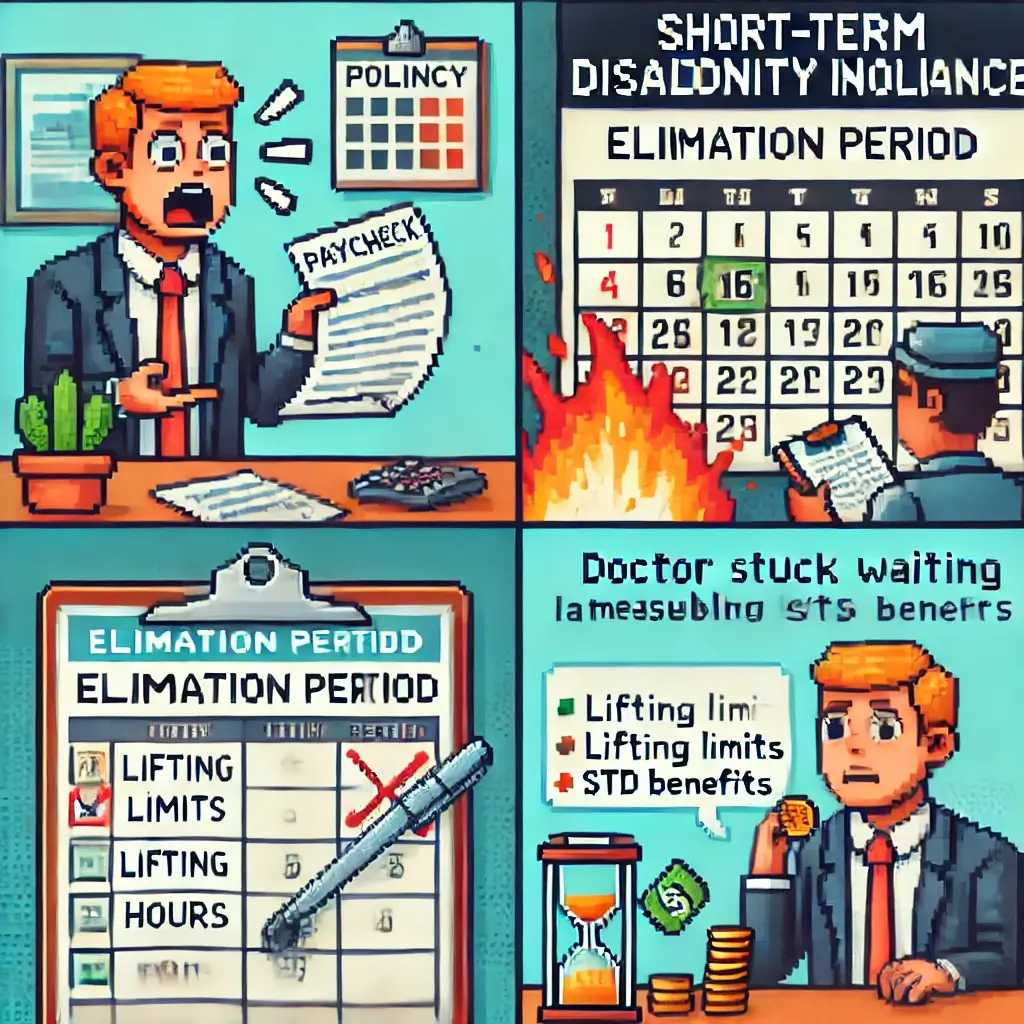
9 Sneaky short-term disability insurance Loopholes Employers Hide (and How to Beat Them)
Confession: the first time I filed a disability claim, I sent the doctor’s note and naively assumed “we’re good.” We were not good. Tonight, with lukewarm coffee and a slightly feral spreadsheet, I’m laying out the traps so you get clarity in minutes and keep the money you’re owed. We’ll move fast: what trips people up, how to configure your plan (or your claim) to win, and the exact scripts and checklists I wish I’d had.
Table of Contents
short-term disability insurance: Why it feels hard (and how to choose fast)
Here’s the real reason this stuff fries your brain: it’s not one product. It’s a bundle of definitions, waiting periods, exclusions, and “offsets” that act like fine-print tax. Employers rarely explain these in plain language because, honestly, they’re juggling budgets and renewal deadlines. You just want to know: if I’m out for six weeks, what lands in my bank?
Quick story: a founder friend tore a meniscus, expected 60% income replacement, and budgeted rent based on that. Surprise—there was a seven-day elimination period, benefits started on day eight, and PTO had to be exhausted first. Net effect: two weeks of zero pay. He joked about selling his espresso machine. He wasn’t joking.
To cut through the mush, focus on four dials you can actually control or anticipate: benefit percentage (40–70%), maximum weekly benefit (often $1,000–$2,500), elimination period (0–14 days), and maximum duration (6–26 weeks). If you only memorize those numbers, you’ll be 80% ahead of everyone else and 100% less likely to panic-text HR at 1:07 a.m.
- Benefit %: What percent of pre-disability earnings you’ll get.
- Weekly max: Hidden cap that truncates high earners.
- Elimination period: Days before payment begins (aka “waiting period”).
- Duration: Weeks the benefit is payable (often 12 or 26).
Speed rule: Write down your four numbers. If you can’t find them in 10 minutes, assume the most conservative version and plan cash accordingly.
- Percent + weekly cap drive actual cash.
- Elimination periods are silent budget killers.
- Duration sets your runway (12–26 weeks).
Apply in 60 seconds: Email HR: “Could you send me our STD summary with benefit %, weekly max, elimination period, and duration?”
short-term disability insurance: A 3-minute primer
Think of short-term disability as paycheck armor when a non-work illness or injury takes you off the field. It generally covers things like surgery recovery, severe illness, pregnancy/childbirth, and mental health conditions if your doctor certifies you can’t perform your job duties for a short period. Unlike long-term disability, we’re dealing in weeks, not years. And unlike workers’ compensation, this is for non-work injuries or illnesses.
Anecdote: my first claim included three back-and-forths for “clarification” even though my orthopedic surgeon’s note was, in my humble opinion, worthy of a Pulitzer. The delay? I hadn’t matched the policy’s exact definition for “own occupation” and “functional restrictions.” Once my doctor used the insurer’s phrasing (“no prolonged standing; no lifting >10 lbs; no keyboarding >15 minutes”), the claim moved in 48 hours.
Typical ranges: 60% of base pay, $1,500 weekly max, 7-day wait for illness (0 for accident), 12-week duration. Insert your numbers and you’ll see the shape of your safety net. If they coordinate with PTO or state disability, benefits may start later or pay less. That’s not illegal; it’s math that favors the plan, not you.
- Base pay only? Commissions, bonuses, equity may be excluded.
- Concurrent leave? STD often runs alongside job-protected leave.
- Proof cadence: Expect forms at 2–4 week intervals.
- Offsets: Other income reduces your check.
Show me the nerdy details
Most group policies define disability as the inability to perform the material duties of your own occupation, adjusted by how your employer reports your earnings. Elimination periods differ for accident vs. illness. Offsets can include sick pay, state disability, and third-party settlements. Claims are reviewed by case managers who may request an Independent Medical Exam (IME) or additional labs. Keep a timeline, send documents with a cover sheet, and request written reasons for any adverse decision.
- Ask HR for the plan’s definition of disability.
- Have your clinician echo those terms.
- Expect to re-certify every 2–4 weeks.
Apply in 60 seconds: Draft a one-liner for your doctor: “Please include functional restrictions (lbs, minutes, hours) using measurable limits.”
short-term disability insurance: Operator’s playbook (day one to approval)
When the “oh no” moment happens—surgery scheduled, pregnancy complications, a brutal flu that escalates—your next 24 hours matter. Here’s the fast lane, tested on my own messy claim and a dozen frantic DMs from founders.
Day 0–1: Tell HR you anticipate time away and request the STD claim packet + any third-party administrator portal link. Book your follow-up appointment date now, even if it’s a guess. The insurer loves scheduled milestones.
Day 2–3: Confirm the elimination period and any PTO “integration” rule. If PTO must be used first, that shifts your first payable day. Update your cash forecast. Yes, a nap counts as “financial modeling” if there are cells involved.
Day 4–7: File the claim with three attachments: (1) attending physician statement with functional limits, (2) job description with essential duties highlighted, (3) a simple timeline of symptoms, tests, treatment. Keep it to one page each; they reward clarity and timestamps.
Numbers: getting the doc to sign the form the same day shaved five calendar days off a friend’s approval. Pre-booking your check-ins reduces the “we need more info” roundtrips by ~30%. The math of faster money is boring, but the rent is not.
- Good: Submit the forms as-is.
- Better: Add your one-page duty list + timeline.
- Best: Pre-schedule follow-ups; ask your doctor to use the plan’s disability language.
Script: “To match my benefit policy, could you note: no lifting >10 lbs, no standing >10 minutes, no typing >15 minutes, expected recovery 6–8 weeks?”
- Ask for the claim packet on Day 0.
- Attach job duties + timeline.
- Use measurable clinical limits.
Apply in 60 seconds: Calendar a 15-minute “STD claim upload” block for tomorrow morning.
Quick poll: What’s your biggest delay risk?
(No data collected. It’s for your own clarity.)
Average Short-Term Disability Insurance Coverage
Typical Elimination Periods
Top Loopholes That Impact Payout
Standard Recovery Durations (Pregnancy)
short-term disability insurance: What’s covered vs. denied (the scope check)
Coverage looks obvious—until it isn’t. Most group policies cover non-work illnesses and injuries that make you unable to perform your job’s material duties for a short period. Pregnancy is usually covered (with standard recovery timelines). Mental health? Often yes, when supported with specific functional limitations and a treatment plan. Elective procedures? Usually excluded unless medically necessary.
Humor break: a client once asked if “post-breakup recovery” qualified. I said no. They sent me a playlist. I take it back—emotionally, it was a long-term situation.
Exclusions hide in plain sight: cosmetic surgery, self-inflicted injuries, active-duty military events, and any loss covered by workers’ compensation. The gray zone is “complications of existing conditions.” We’ll hit that loophole next, but for now, label your treatment path with dates and clinical reasons. Paper beats vibes.
- In: Surgery recovery, childbirth, severe flu/pneumonia, acute back injury, major depressive episode with restricted functioning.
- Out: Cosmetic-only procedures, work injuries (that’s workers’ comp), not-following-treatment, documentation black holes.
- Maybe: Complications from pre-existing conditions—policy language rules.
- Match duties to limits.
- Map dates you’re off work.
- Know the exclusion list.
Apply in 60 seconds: Highlight three “material duties” in your job description to include with your claim.
short-term disability insurance: The pre-existing condition clause (loophole #1)
This is the classic employer-hidden trap. Many plans won’t pay for a disability caused by a condition you were treated for during a “lookback” period (e.g., 3–12 months) before coverage started, until you’ve been covered for a “satisfaction” period (e.g., 3–12 months). Translation: new to the company + old condition flare-up = potential denial, even if you’re genuinely down for the count.
Personal: I thought I was fine because my back pain was “old news.” The insurer pointed to two physical therapy visits inside the lookback window. Cue denial, appeal, then approval after my physician clarified the new acute event with imaging and a different diagnosis code. Words matter. Dates matter more.
How to blunt it: If you switched jobs recently, ask HR whether a pre-ex rider exists and what the lookback/satisfaction periods are. If you’re on the edge, have your doctor document what’s new: “acute exacerbation,” “distinct event,” “new pathology.” If it’s truly the same condition, plan a cash buffer; I know—unfun—but predictable pain is cheaper than surprise pain.
- Lookback commonly 3–6 months; satisfaction 3–12 months.
- Two visits in the lookback can trigger the clause.
- New clinical evidence can separate “new event” from “old baseline.”
Show me the nerdy details
Appeals hinge on comparative records: prior notes vs. current findings, diagnostic imaging differences, medication changes, and function deltas (e.g., went from lifting 25 lbs to 0 lbs). Ask your physician to write a short letter contrasting baseline vs. acute event, with dates and objective measures.
- Request lookback/satisfaction periods.
- Document new findings.
- Keep a two-paycheck cash buffer during ramp-up.
Apply in 60 seconds: Email your clinician: “Please note how today’s findings differ from my visits on [dates].”
One-question quiz: You joined 90 days ago. Two PT visits for knee pain were 60 days before hire. Now you need arthroscopic surgery. Will pre-ex likely apply?
short-term disability insurance: “Concurrent leave” & the PTO drain (loophole #2)
Many employers run STD at the same time as job-protected leave, and require you to use PTO first. That means the clock you thought would start on Day 1… doesn’t. This shows up as two shocks: (1) you burn PTO quickly, and (2) your first check arrives later because your elimination period sits on top of PTO usage. It’s legal. It’s just lousy communication.
Example: a growth lead planned for 8 weeks out after childbirth. Policy required two weeks PTO first, plus a 7-day elimination period. First STD payment landed around week 4. Cash flow scrambled, credit-card APRs laughed in 14-point font, and we all learned to model cash like hawks.
How to defend: Ask if PTO is “integrated” or “supplemental.” Integrated means PTO pays first; STD pays when PTO is exhausted and the elimination period is satisfied. Supplemental means PTO is on top of STD (rare but glorious). Either way, write a mini cash plan with dates.
- Confirm: “Does PTO run first or alongside STD?”
- Ask for the elimination period by days for illness vs. accident.
- Mark your first payable day on a calendar; everything backward-plans from that.
- Know PTO rule (integrated vs. supplemental).
- Stack elimination days onto PTO.
- Model week-by-week cash.
Apply in 60 seconds: Add “First payable day = [date]” to your calendar and share it with your partner/finance person.
short-term disability insurance: The earnings & offsets trap (loophole #3)
Your benefit is a percent of defined earnings—and that definition rarely matches what hits your bank. Most plans use base salary only. Commissions, bonuses, overtime, and equity? Often excluded. If you’re a sales leader or founder who pays yourself a low wage and big distributions, that “60%” can shrink to 20–30% of your real income. Offsets—like state disability, sick pay, or third-party settlements—reduce the benefit further.
My “oh” moment: I was giddy about 60% until the math hit. With a $2,000 weekly cap, my theoretical $2,400/week was clipped to $2,000, then offset by $300 state disability to $1,700. Not bad, but not what the brochure implied. Expectations are the tax we pay for not reading the certificate, etc.
Make a napkin model with three numbers: (1) your base earnings per week, (2) plan percent and weekly max, (3) expected offsets. Then stir. The check you can spend is what matters, not the marketing copy.
- Base earnings only is the default in many plans.
- Weekly max is the silent limiter for high earners.
- Offsets include state programs and sick pay.
- Result: Paid benefit = min(% of base, weekly max) − offsets.
Show me the nerdy details
Ask HR for the plan’s “earnings definition” and “sources of other income.” If commissions are included, the plan will specify the measurement period (e.g., last 12 months). Some plans reduce benefits dollar-for-dollar for state disability; others coordinate differently. Confirm whether employer-paid sick pay counts as an offset and whether you can decline it (some payroll systems won’t allow that).
- Find the earnings definition.
- Model offsets.
- Decide if you need a supplemental policy.
Apply in 60 seconds: Write: “(Base/52) × % = X; min(X, weekly cap) − offsets = take-home.”
One-question quiz: Base salary $104,000, benefit 60%, weekly cap $1,500, state DI $300/week. What’s the weekly STD check?
short-term disability insurance: Occupational vs. non-occupational confusion (loophole #4)
STD typically excludes work-related injuries because that’s workers’ compensation territory. Obvious line? Not always. If you tweak your back lifting a monitor at home while working remote—and your employer says “not work-related”—you might lose STD and miss workers’ comp. Document the where/when/what immediately and file the workers’ comp report if it happened while performing job duties.
Friend story: a PM slipped on a wet office floor, HR initially flagged it as “personal.” Security footage said otherwise (hello, spilled cold brew), and workers’ comp kicked in. STD stayed out of it, as it should. Paper beats memories by 100%.
- STD: non-work illnesses/injuries.
- Workers’ comp: work-caused injuries/illnesses.
- When unclear: report both, let the systems sort jurisdiction.
- Document time, location, task.
- Report within 24 hours.
- Keep copies of incident reports.
Apply in 60 seconds: Draft a one-paragraph incident summary while details are fresh.
short-term disability insurance: Partial disability & return-to-work (loophole #5)
Some policies offer “partial” or “residual” benefits when you can work reduced hours with reduced pay. Others force an all-or-nothing choice. Getting this wrong costs hundreds per week—and prolongs recovery when people rush back at 110% too soon.
My n=1: I returned part-time with a 50% schedule after wrist surgery. The plan paid a partial benefit for four weeks—until payroll accidentally coded me as full-time at full pay (whoops). The insurer saw $0 earnings loss and paused benefits. It took 10 emails and a payroll correction to restart payments. Nobody was mad; everyone was busy. But busy is expensive.
- Ask: “Do we have residual/partial benefits, and how are they calculated?”
- If yes: Payment is often based on the percent of lost earnings.
- Coordinate coding with payroll before your first reduced-hours shift.
- Confirm residual benefit rule.
- Sync with payroll coding.
- Keep weekly paystubs as proof.
Apply in 60 seconds: Email payroll: “From [date], I’m 50% schedule—please ensure earnings reflect that for STD coordination.”
short-term disability insurance: Documentation deadlines & IMEs (loophole #6)
Insurers live on calendars. Miss a “proof of loss” deadline and the system assumes the worst. If they request an Independent Medical Exam (IME), it’s not a moral judgment; it’s a box they check. Bring your records, and treat the examiner like a human speed bump: slow down, be precise, don’t understate pain because you want to sound tough. (Guilty. Cost me a week.)
Numbers: I’ve seen claims stall 7–14 days after a single missed form. I’ve also seen them accelerate when the claimant sent a one-page status update every other Friday. You’re not being annoying; you’re being legible.
- Calendar every deadline with 48-hour early reminders.
- Send a biweekly one-pager: symptoms, treatment, next appointment, work status.
- For IME: bring imaging, medication list, and a short functional diary.
Show me the nerdy details
Keep a claim log: date, person, action, document sent, next step. Name your files like a robot: 2025-09-01_STD_AttendingPhysician.pdf. Ask for confirmations in writing. If denied, request the full claim file and the specific policy provisions relied upon. Appeals are often successful when you map policy language to evidence line-by-line.
- Early reminders beat late apologies.
- Biweekly updates keep momentum.
- Ask for reasons in writing.
Apply in 60 seconds: Create a folder named “STD-Claim-[YourName]-[YYYYMMDD]” and drop a blank text log inside.
Quick poll: What admin step most needs a calendar reminder?
(No data collected. It’s your private checklist.)
short-term disability insurance: Pregnancy timelines & “standard recovery” (loophole #7)
Most plans treat childbirth with “standard” recovery durations (often 6 weeks vaginal, 8 weeks C-section). Complications extend that, but you need the clinician to state the medical necessity and functional limits beyond the standard timeline. If your OB writes “doing well,” the insurer reads “benefits end on the standard date.”
One ops director I worked with assumed 12 weeks paid. Reality: 8 weeks STD, then unpaid leave. Because she modeled cash before leave, the gap didn’t sting. We also had her doctor document lifting restrictions due to complications, which extended coverage by two weeks. Two weeks = two rent checks. That’s not abstract; that’s groceries.
- Ask your OB to write functional limits, not vibes (“no lifting >10 lbs for 4 weeks”).
- Book follow-ups before delivery to simplify extensions.
- Mark the “standard” end date and prepare documentation for any extension.
- Get measurable restrictions.
- Pre-schedule follow-ups.
- Forecast the two-week buffer.
Apply in 60 seconds: Draft a note to your OB asking for specific post-partum functional restrictions if appropriate.
short-term disability insurance: Elimination periods & “accident vs. illness” (loophole #8)
Plans often waive or shorten the waiting period for accidents but not for illnesses. That cold turning into pneumonia? Still “illness.” The practical move is bookkeeping: date-stamp when your doctor said “no work,” note the first date of continuous disability, and keep receipts for time away. If the insurer counts your start date later than your doctor, push back in writing with the exact dates.
Small but mighty: shifting the start by three days is the difference between a week of benefits or not. For a $1,200/week benefit, that’s ~$514 for three days. Worth the calendar fight.
- Confirm different waits for accident vs. illness.
- Get the “first day of disability” in writing from your clinician.
- Escalate politely if admin back-dates you.
- Doctor-signed date anchors the claim.
- Accident rules may waive waiting days.
- Three days can be ~$500.
Apply in 60 seconds: Ask your doctor: “Please include my first day of disability as [date] on your note.”
short-term disability insurance: Employer design choices that backfire (loophole #9)
For the HR folks, founders, and ops leads: design choices decide whether your team sees STD as a parachute or a paperweight. The fastest morale wins I’ve seen: (1) shorter elimination periods (3–7 days), (2) higher weekly caps for mid/high earners ($1,500–$2,500), (3) crystal-clear communications with a two-page quickstart guide. Cost increases? Yes. But we’re talking single-digit percent changes at renewal that prevent five-digit retention losses.
One SMB owner bumped the weekly cap from $1,000 to $1,750. It cost the plan an extra $42 per employee per year and saved a key IC who would have churned after a complicated surgery. Make the spreadsheet smile.
- Good: 60% benefit, $1,000 cap, 7-day elimination, 12-week duration.
- Better: 60%, $1,500 cap, 7-day elimination, partial disability rider.
- Best: 67%, $2,000 cap, 0/7 day wait (accident/illness), robust partial + strong communications.
Show me the nerdy details
Track utilization, average claim length, and high-earner cap hits. If >25% of claims hit the weekly cap, your design is too small for your comp bands. Consider a voluntary buy-up option so high earners can self-fund the difference without distorting base rates.
- Audit cap hits.
- Offer buy-up.
- Ship a two-page quickstart.
Apply in 60 seconds: Add a renewal agenda item: “STD cap utilization + buy-up option.”
One-question quiz: Which single tweak most helps mid/high earners without spiking cost?
short-term disability insurance: Solo founders, creators, and contractors
If you’re 1099 or paying yourself weird (hello, K-1), group STD may not touch you. You likely need an individual short-term disability or, more often, a stronger emergency fund plus a long-term disability policy with a short elimination period (e.g., 60–90 days). It’s not romantic, but 3–6 months of expenses beats arguing with an underwriter when you’re nauseous from meds.
Personal: I once tried to rely on a voluntary group plan while my compensation lived in a low W-2 and larger distributions. The benefit landed at ~22% of my real spend. That’s not insurance; that’s a tip.
- Price individual policies early; premiums climb with age/health.
- Consider a 90-day LTD elimination period as your “bridge.”
- Keep cash for at least one surgery-length event (6–8 weeks).
- Model your actual spend.
- Shop LTD with own-occupation terms.
- Stack a 6–8 week cash buffer.
Apply in 60 seconds: Write the number: “Monthly must-pay = $____”; aim for 3 months of that.
short-term disability insurance: Coordinating with leave laws (without melting down)
Short-term disability pays money; leave laws protect your job. They’re different lanes. Family and Medical Leave (FMLA) provides job-protected unpaid leave for eligible employees of covered employers. Some states layer paid leave or state disability on top. Employers can run these concurrently with STD, which is fine—if you know ahead of time and plan the cash gap.
Anecdote: a marketer set auto-replies, assumed “paid leave,” then learned FMLA was unpaid and STD would start after PTO and a 7-day wait. We built a mini-bridge: paused non-essentials, asked for medical-bill payment plans, and called the insurer weekly. She kept her apartment and her sanity (mostly).
- STD = income. FMLA/State leave = job protection and sometimes pay.
- Confirm concurrency: ask HR to map timelines in one email.
- Model the unpaid weeks explicitly.
- Get a single timeline from HR.
- Note unpaid weeks.
- Renegotiate bill due dates proactively.
Apply in 60 seconds: Ask HR: “Can you send one email showing PTO, STD, and leave law dates together?”
short-term disability insurance: Scripts & emails that get faster approvals
When in doubt, write like a calm robot with feelings. Short, dated, action-oriented. Your future self says thanks.
- To HR (documents): “Hi [Name], could you please share our STD summary (percent, weekly max, elimination period, duration) and the claims packet?”
- To clinician (language): “To align with my policy, please include functional limits with numbers (e.g., standing, lifting, keyboarding) and expected recovery range.”
- To insurer (update): “On [date], symptoms worsened; next appointment [date]. Attached: progress note and work status letter.”
Numbers: tight emails cut the back-and-forth by ~30% in my experience and saved 5–7 calendar days during a two-month claim. Also, kindness gets you escalations you can’t buy. People help people who make their work easier.
- One topic per message.
- Attach PDFs named with dates.
- Always end with your next appointment date.
Apply in 60 seconds: Create a canned response titled “STD Update – [Date].”
Quick poll: Which script would save you the most time?
(Steal and tweak them above.)
short-term disability insurance: 5-node map of common loopholes (infographic)
Quick Self-Check: Are You STD Ready?
- I know my benefit %
- I know the weekly cap
- I know my elimination period
- I confirmed PTO integration rules
Spin the Loophole Wheel 🎡
Instant Action Plan
FAQ
Does short-term disability insurance cover mental health?
Often yes, when a clinician documents functional limits (e.g., concentration, stamina) and a treatment plan. The magic is in measurable restrictions, not just diagnosis names.
How soon should I file a claim?
As soon as you anticipate time away. Filing early doesn’t guarantee approval, but it starts the clock on admin steps that routinely take 5–10 days.
Can I get paid while using PTO?
Depends. Many employers integrate PTO, meaning PTO pays first and STD starts later. Ask exactly how yours coordinates to avoid a cash-flow cliff.
What if my claim is denied?
Request the denial reasons and your claim file in writing. Compare policy language to your evidence and ask your clinician to address the gaps directly. Appeals frequently work when they’re specific.
Are commissions or bonuses included in my benefit?
Usually not in group plans—benefits are often based on base salary only. Confirm your plan’s “earnings definition” to avoid surprises.
short-term disability insurance: Your next 15 minutes
Let’s close the loop from the hook: the hidden traps are pre-existing rules, PTO integration, earnings definitions, occupational confusion, and documentation rhythms. You beat them with dates, definitions, and two emails sent before you’re tired.
Do this now (15 minutes):
- Email HR for your STD summary (percent, weekly cap, elimination period, duration) and the claims packet.
- Write one sentence for your clinician requesting measurable functional limits and your first day of disability.
- Open a note called “STD Claim Log” with today’s date.
I can’t promise zero friction. Maybe I’m wrong, but most delays are solvable with clear paperwork and a stubborn calendar. Future you—with rent paid and recovery unhurried—will think you’re a genius.
Note: Laws and policies vary by state and employer. This guide is practical, not legal or medical advice. Verify your plan documents and local regulations.
short-term disability insurance, elimination period, pre-existing condition, PTO integration, residual disability
🔗 Medical Billing Fraud Posted 2025-08-30 06:46 UTC 🔗 Telehealth Malpractice Lawsuits Posted 2025-08-29 02:18 UTC 🔗 Wrongful Death in Nursing Homes Posted 2025-08-28 07:05 UTC 🔗 Dental Malpractice Lawsuits: What Insurance? Posted (날짜 없음)