
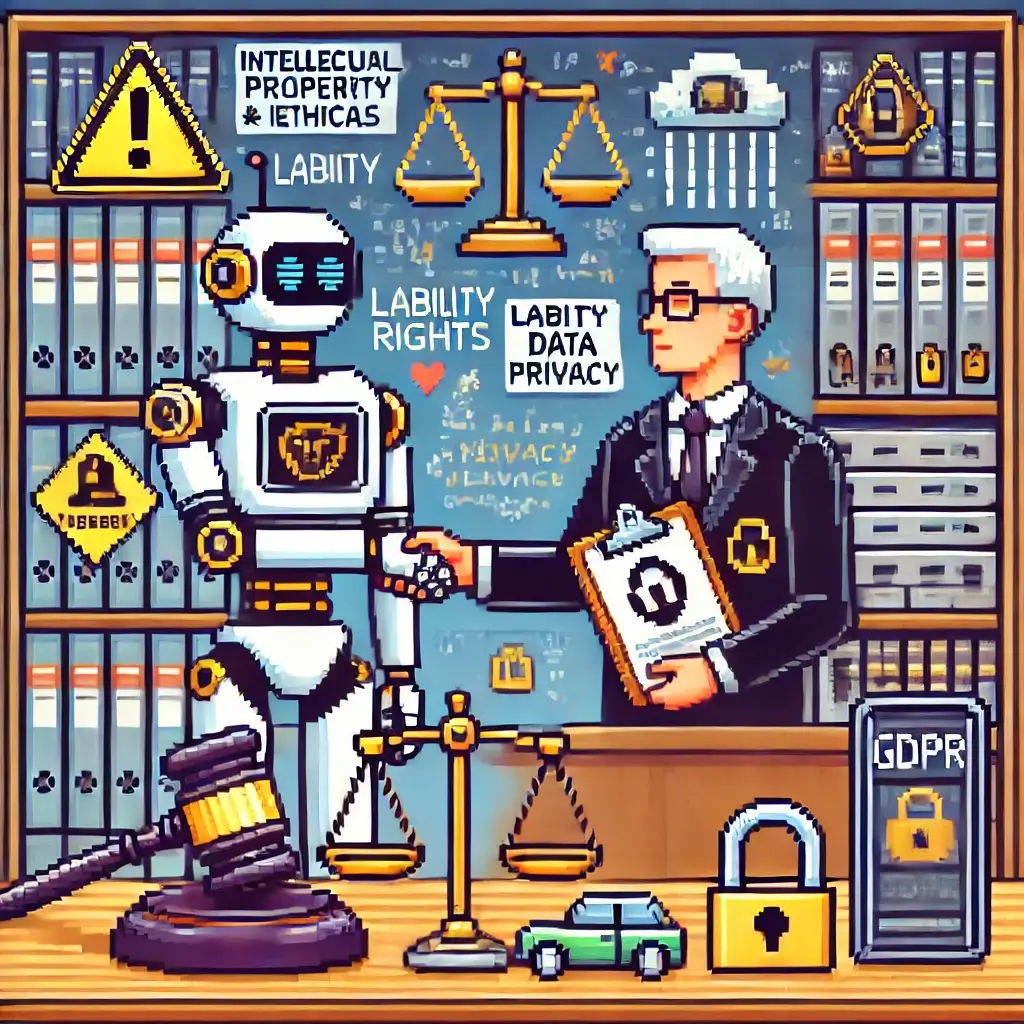
7 Legal Quagmires of Our Robot Co-Workers: What You MUST Know!
Hello there!
You’re probably here because the future of work isn’t just a sci-fi movie anymore.
It’s a reality where robots and AI aren’t just in factories; they’re sitting right next to us, collaborating on projects, writing code, and even serving coffee.
As someone who’s spent years navigating the tangled web of corporate law, let me tell you, this isn’t just about cool tech.
It’s about a seismic shift in how we define a “workforce,” and it brings a whole new set of legal and ethical puzzles.
I’ve seen companies stumble into these issues firsthand, and believe me, it’s not pretty.
The stakes are high, and the risks—from lawsuits to reputational damage—are very real.
This isn’t just some dry legal brief.
Think of this as a candid, no-nonsense chat with a friend who happens to be a lawyer, giving you the real scoop on what to watch out for.
We’re going to break down the **legal implications of an augmented workforce** into seven key areas you absolutely need to understand.
Let’s dive in before your new robot colleague sends you a memo!
—
Table of Contents
—
1. Who’s to Blame? The Liability Labyrinth of Human-Robot Collaboration
This is the big one, the question that keeps C-suite executives and their legal teams up at night.
Imagine a robot arm assisting a human on an assembly line.
The robot malfunctions, causing injury to the worker.
Who is liable?
Is it the company that owns the robot?
The manufacturer who designed it?
The software developer who wrote the faulty code?
Or perhaps the human worker who was operating it?
It’s a complete mess, a legal Gordian knot.
Traditional tort law, which is built on the concept of human negligence, just doesn’t quite fit.
It’s like trying to put a square peg in a circular hole.
We have legal precedents for product liability, where a manufacturer can be held liable for a defective product.
But what if the “defect” is a learning algorithm that went haywire on its own?
This is where it gets really interesting, and really scary for companies.
We’re seeing a push for new legal frameworks.
Some scholars suggest creating a new category of legal personhood for robots, which, let’s be honest, sounds like something out of a B-movie, but the debate is very real.
Others argue for a strict liability standard, meaning the company that deploys the robot is always responsible, regardless of fault.
This is a tough pill to swallow for businesses, but it might be the only way to ensure accountability.
For now, the best practice is to have an iron-clad contract with your tech provider and to carry a massive insurance policy.
Believe me, you don’t want to be the test case for this.
—
2. The Digital Ghost in the Machine: Data Privacy and the Augmented Workforce
In the world of augmented work, data is the new oil, and our robot co-workers are the biggest drillers.
They collect a mind-boggling amount of data.
Think about it: a robot that tracks a human’s movements, productivity metrics, and even their emotional state through biometrics.
This isn’t just about a simple time clock anymore.
This is about a detailed, minute-by-minute record of a person’s life at work.
And with great data comes great responsibility—and great risk.
The first issue is **consent**.
Do employees fully understand what data is being collected and how it’s being used?
Or is it buried in some 50-page user agreement they barely glance at?
This is a prime area for class-action lawsuits.
Then there’s the question of **security**.
Who is responsible if a robot’s database is hacked, and sensitive employee information is leaked?
This could lead to massive fines under regulations like GDPR in Europe or various state laws in the U.S.
It’s a compliance minefield.
To navigate this, companies need a robust data governance strategy.
This means clear policies, transparent communication with employees, and, most importantly, a solid cybersecurity plan.
Because if a robot can collect the data, a hacker can probably steal it.
And trust me, a data breach is a nightmare you don’t want to wake up from.
—
3. Whose Idea Was That, Anyway? Intellectual Property Rights in the Age of AI
This is one of my favorite legal puzzles, and it’s a doozy.
Imagine an AI system that helps a human designer create a new product.
The AI suggests a unique shape, and the human refines it.
Who owns the patent on that new product?
The human designer?
The company that owns the AI?
The company that created the AI?
This isn’t some abstract thought experiment.
The U.S. Patent and Trademark Office and courts around the world are grappling with this right now.
Current law generally holds that an inventor must be a “natural person.”
But as AI becomes more autonomous and creative, that definition is getting stretched to its breaking point.
It’s like trying to fit a genie back into its bottle.
We’re seeing cases where AI is listed as a co-inventor, but the legal system isn’t quite sure what to do with that.
This lack of clarity is a huge problem for businesses.
It creates uncertainty and can devalue the very innovations companies are pouring billions into.
To protect themselves, companies need to get creative.
This might mean updating employment contracts to explicitly address AI-assisted intellectual property, or even lobbying for new laws.
The bottom line is, if you’re using AI to create, you better have a plan for who owns the masterpiece.
—
4. The Robot in the Breakroom: Labor and Employment Law Quandaries
Here’s a question for you: is a robot an “employee”?
Of course not, you say.
But the way we use robots in the workplace can have a massive ripple effect on human employees and their legal rights.
Think about **job displacement**.
When robots take over tasks, jobs are lost.
While this isn’t a direct legal issue in most cases, it raises huge ethical questions and can lead to public backlash and even calls for new taxes on robots to fund unemployment benefits.
Then there’s the issue of **discrimination**.
What if an AI-powered hiring tool is biased and systematically screens out candidates based on race or gender?
Even if the bias is unintentional—a result of the training data—the company is still on the hook for a potential discrimination lawsuit.
Ignorance is not a valid defense here.
And let’s not forget **workplace monitoring**.
Robots that track everything an employee does can be seen as a violation of privacy.
Union contracts often have clauses about this, and the legal landscape is getting trickier every day.
Companies need to be transparent about how and why they use these technologies and ensure they have a defensible legal reason for their use.
You don’t want to be the company that’s found to be secretly surveilling its employees.
—
5. Safety First, Robot Second? A Deep Dive into Worker Safety
When we talk about worker safety, our minds usually go to things like hard hats and safety glasses.
But what about when the most dangerous thing in the room is a machine that’s supposed to be helping you?
Human-robot collaboration introduces a new layer of risk.
A sudden, unexpected movement by a robot could lead to a serious injury.
This isn’t just about physical safety, either.
There’s a growing concern about **psychological safety**.
Imagine the stress of working side-by-side with a machine that’s always tracking your performance, never taking a break, and never complaining.
This kind of pressure can lead to burnout, anxiety, and a host of other mental health issues.
From a legal standpoint, companies have a “duty of care” to their employees.
This duty extends to ensuring the safety of a human-robot workspace.
This means not just physical barriers and emergency stop buttons, but also comprehensive training for human workers, clear protocols for what to do in case of a malfunction, and even monitoring the mental well-being of the workforce.
Ignoring this can lead to massive worker’s compensation claims and regulatory fines.
And trust me, OSHA doesn’t mess around.
They will fine you into the stone age.
—
6. Beyond the Law: Ethical Considerations of an Augmented Workforce
Legal and ethical are not the same thing.
Something can be legal but still ethically questionable.
The rise of the **augmented workforce** raises some truly profound ethical questions that a lawyer’s brief can’t solve.
For starters, there’s the **moral responsibility of the robot**.
Can a robot be held morally responsible for its actions?
This is the kind of philosophical debate that’s been around for decades, but it’s now a very practical business problem.
Then there’s the **human element**.
As we augment our workforce with robots, do we risk dehumanizing work?
What happens to a person’s sense of purpose and identity when they’re simply a cog in a machine-driven process?
These are not small questions.
They impact morale, employee retention, and a company’s reputation.
It’s about doing the right thing, not just the legal thing.
Companies need to establish a strong ethical framework.
This means involving ethicists, not just lawyers, in the development and deployment of new technologies.
It’s about building a culture where technology is used to empower humans, not replace them.
—
7. The Path Forward: Navigating the Legal Frontier of Human-Robot Teaming
So, what’s the takeaway from all this?
The future of work is here, and it’s complicated.
The **augmented workforce** is a game-changer, and the legal system is still playing catch-up.
For businesses, this means you can’t afford to be reactive.
You need to be proactive.
This isn’t a problem you can solve by just hiring a lawyer after something goes wrong.
It requires a holistic, cross-functional approach.
Engage your legal, HR, and tech teams from the very beginning.
Create clear policies, get your contracts in order, and, most importantly, be transparent with your human employees.
The companies that succeed won’t be the ones with the most robots.
They’ll be the ones that master the art of human-robot collaboration, not just technologically, but legally and ethically.
And trust me, that’s a much harder, and more important, puzzle to solve.
The legal implications of an **augmented workforce** are complex, but with the right approach, they’re not insurmountable.
Stay smart, stay safe, and don’t let the robots take over—at least not in the legal sense.
We’ve covered a lot of ground here, but if you have a specific question about your company’s situation, I’d love to hear from you.
Let’s talk.
This is an incredible moment in history, and it’s up to us to make sure we get the rules right.
Don’t be afraid to be a trailblazer, but do it with your eyes wide open.
I’ve seen the good, the bad, and the ugly, and trust me, you want to be on the right side of history on this one.
It’s not about being anti-robot; it’s about being pro-human.
We need to design a future where humans and robots work together to create a better, more prosperous, and more equitable world for everyone.
This isn’t just about avoiding a lawsuit; it’s about building a better society.
And that’s a mission we can all get behind.
The **augmented workforce** will continue to evolve, and so will the laws surrounding it.
Stay informed, stay proactive, and always, always, put people first.
That’s the best legal advice I can give you on this topic.
I’ve been in boardrooms where the very best legal minds in the world are stumped by these questions.
It’s not as simple as flipping a switch or reading a statute.
It’s about foresight, strategy, and a willingness to adapt.
We are literally writing the rules as we go, and it’s a huge responsibility.
And hey, if your robot co-worker starts making better coffee than you, you might have a different kind of problem to deal with.
Just kidding… mostly.
But in all seriousness, the most important thing you can do is to start the conversation now, before you need to have it in a courtroom.
And remember, the legal challenges are just a symptom of a deeper transformation.
The companies that succeed will be those that embrace this change and lead with a clear vision, a strong ethical compass, and a healthy dose of common sense.
It’s a bumpy road ahead, but it’s an exciting one.
I’ll see you on the other side.
And if you want to know more about the nuts and bolts of drafting a technology contract, let me know.
It’s a whole other ballgame.
Navigating the Legal Maze: A Visual Guide
The 7 Pillars of Augmented Workforce Legal Risk
Liability
Who is responsible when a robot malfunctions?
Data Privacy
Securing sensitive employee data collected by AI.
IP Rights
Who owns creations made with an AI partner?
Labor & Employment
Fairness in hiring, displacement, and monitoring.
Worker Safety
Protecting both physical and psychological well-being.
Ethics
The moral questions beyond legal compliance.
Regulatory Compliance
Staying ahead of evolving laws and standards.
The **augmented workforce** isn’t going anywhere.
It’s a new frontier, and like any frontier, it’s full of opportunity and peril.
You need to be prepared for the legal implications, but also for the ethical and societal ones.
The companies that get this right will not only thrive but will also be leaders in shaping a more responsible and humane future of work.
It’s a win-win, really.
I’ve seen the look on a CEO’s face when I explain the legal exposure of a new AI system they’ve just launched without a proper legal review.
It’s a mix of shock, fear, and a lot of regret.
Don’t let that be you.
Get ahead of the curve.
And if you see a robot in the breakroom, offer it some digital coffee.
It might be listening.
There’s so much more to discuss on this topic, from the specifics of international law to the role of future regulatory bodies.
But for now, I hope this has given you a solid foundation and maybe, just maybe, a good reason to call your lawyer before your next big tech rollout.
Legal implications, Augmented workforce, Human-robot collaboration, Data privacy, Intellectual property.
🔗 Digital Nomad Visa Traps Posted 2025-08-15 03:57 UTC 🔗 Ethical Fashion Supply Chain Audits Posted 2025-08-16 07:06 UTC 🔗 Forensic Accounting Posted 2025-08-16 09:54 UTC 🔗 Off-Grid Water Collection Laws Posted 2025-08-17 02:51 UTC 🔗 Bulletproof CSA Legal Structure Posted Unknown Date 🔗 Your Farm, Your Future: 3 Legal Pillars Posted Unknown Date