
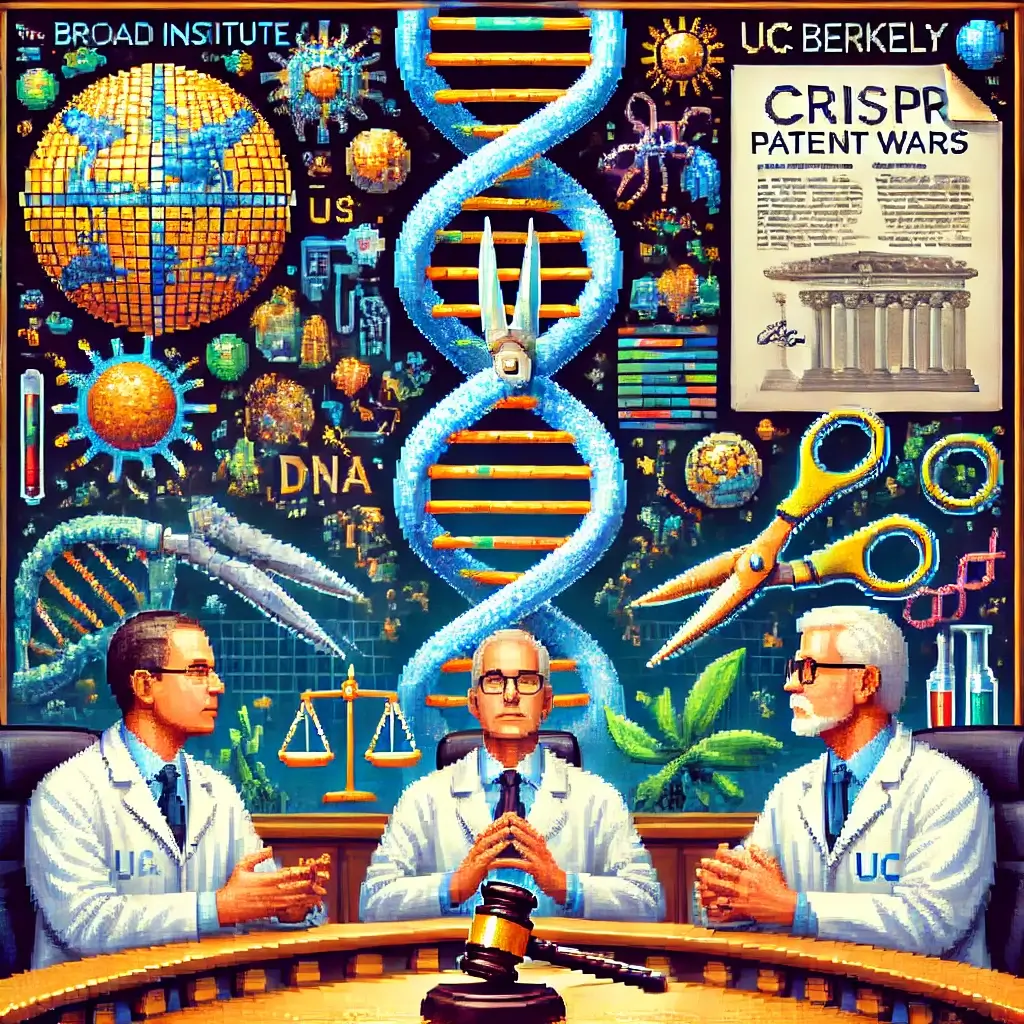
The $100 Billion Gene Editing War: 3 CRISPR Patent Fights That Shook the World!
I’m going to be straight with you: gene editing is a gold rush, and the gold is intellectual property. We’re talking about patents on technologies that could cure diseases, transform agriculture, and maybe even change what it means to be human. It’s no wonder the fight over these patents is so fierce, so dramatic, and so incredibly high-stakes. The legal battles aren’t just a bunch of stuffy lawyers in a courtroom; they are the front line of a war for the future of science and medicine. And let me tell you, it’s a war that’s already costing billions.
You see, the first person to invent something doesn’t always get the patent. Sometimes, it’s a race to the patent office. Sometimes, it’s a battle of who can prove they were “first to invent.” The rules are complex, the evidence is often hidden in lab notebooks and old emails, and the consequences of losing are catastrophic. We’re talking about losing the rights to a technology that could be worth a fortune. So, grab a coffee and settle in, because we’re about to dive into the epic saga of gene editing patent law. This isn’t just about legal jargon; it’s about genius, ambition, betrayal, and the future of humanity.
Table of Contents
- The Genesis of the Battle: What is Gene Editing Patent Law?
- The First Salvo: The Broad Institute vs. Berkeley Showdown
- The CRISPR Clones: Who Invented What, and When?
- The Second Front: The Cas9 Patent Wars Abroad
- CRISPR’s Cousins: Other Gene Editing Technologies
- The Future of Gene Editing Patents: What’s Next?
- Beyond the Courtroom: The Ethical and Societal Impact
- 3 Critical CRISPR Patent Fights: A Deep Dive
- My Take: A Personal Story from the Trenches
- Conclusion: A Final Thought on Innovation and IP
The Genesis of the Battle: What is Gene Editing Patent Law?
Okay, let’s start with the basics. What exactly is a patent, and why is it so important in the world of gene editing? Think of a patent like a deed to a house. It gives you the exclusive right to a specific invention for a set period, usually 20 years. For that time, you can stop anyone else from making, using, or selling your invention without your permission. It’s a legal monopoly, and in the case of CRISPR, it’s a monopoly on the ability to precisely edit DNA. That’s a pretty powerful monopoly, wouldn’t you agree?
The problem is, gene editing isn’t a single invention. It’s a whole field of different tools and techniques. You have CRISPR-Cas9, which is the most famous, but you also have TALENs, ZFNs, and now a new generation of “prime editing” tools. Each one of these can be patented, and the patents can cover a lot of ground. They can cover the technology itself, the specific genes it’s used to edit, and even the therapeutic applications that result from the editing. It’s a legal minefield, and everyone is trying to plant their flags on as much of the territory as possible. It’s like the Wild West, but with lawyers instead of cowboys and DNA instead of gold.
And the law itself is a moving target. In the US, the rules changed in 2013 from a “first-to-invent” system to a “first-to-file” system. That means it’s a race to the patent office. But a lot of the initial CRISPR work happened before that change, so some of the biggest battles are being fought under the old rules. It’s a complicated mess, and a single judge’s decision can literally reshape the entire landscape of biotechnology. That’s why these court cases are so closely watched. The stakes are just so incredibly high. They’re not just fighting over patents; they’re fighting over the ability to innovate and profit from the next generation of medicine.
The First Salvo: The Broad Institute vs. Berkeley Showdown
This is the big one. The heavyweight title fight of gene editing patent law. In one corner, you have the University of California, Berkeley, and Jennifer Doudna. In the other corner, you have the Broad Institute of MIT and Harvard, and Feng Zhang. Both teams did groundbreaking work on CRISPR-Cas9, but their paths and their patent applications diverged, leading to a legal clash of the titans. It’s a story of two scientific teams working in parallel, each believing they were the first to make a key discovery.
Doudna and her collaborator, Emmanuelle Charpentier, published a seminal paper in 2012 showing that CRISPR-Cas9 could be used to cut DNA in a test tube. It was a huge breakthrough. But what they didn’t show was that it could work inside a living eukaryotic cell—like the cells in your body. That’s where the Broad Institute comes in. Feng Zhang’s team published their own paper in 2013, demonstrating that CRISPR-Cas9 could be used to edit genes in eukaryotic cells. This was a critical step, as it proved the technology’s potential for therapeutic use.
The fight boils down to this: Who was first to invent the use of CRISPR in eukaryotic cells? The Berkeley team argued that their earlier work made it obvious to anyone in the field that the technology would also work in eukaryotic cells. The Broad Institute argued that their invention was not obvious and required a separate, non-obvious leap of innovation. This isn’t just a simple technical disagreement. This is a multi-billion dollar fight over a key patent. The U.S. Patent and Trademark Office has sided with the Broad Institute on this crucial point, but the fight is far from over. There are appeals, new claims, and more lawyers than you can shake a stick at. It’s a never-ending saga, and it has everyone on the edge of their seats.
The CRISPR Clones: Who Invented What, and When?
Here’s where things get even more tangled. It’s not just one big fight, but a whole series of smaller ones. Think of it like a family feud where everyone is suing everyone else. The key players in the CRISPR patent saga are all interconnected, and their claims often overlap. The initial discovery of CRISPR in bacteria was made by several groups long before anyone realized its potential as a gene editing tool. Then, you have the development of the Cas9 protein, which is the “scissors” of the CRISPR system. Who gets credit for that? It’s a complicated web of publications, patent filings, and scientific collaborations.
The core of the problem is that science doesn’t happen in a vacuum. Scientists build on each other’s work. Doudna and Charpentier built on the work of others who had studied CRISPR in bacteria. Zhang built on their work. And now, countless other labs are building on the work of all of them. So, where do you draw the line? At what point does an improvement become a new, patentable invention? This is the central question that the patent office and the courts are trying to answer. It’s a gray area, and the answers are often unsatisfying to all parties involved.
The key dates and publications are scrutinized with a level of detail that would make a forensic detective jealous. Lab notebooks are brought out, emails are analyzed, and timelines are reconstructed to the hour. For example, did one team have a working prototype just a few days before another team filed their patent application? These small details can have monumental consequences. It’s a high-stakes game of “he said, she said,” but with billions of dollars on the line. And the scientific community is watching with bated breath, because the outcome of these cases will determine who controls the future of genetic medicine.
The Second Front: The Cas9 Patent Wars Abroad
The patent fights aren’t just happening in the United States. The same battles are being fought in Europe, China, and other countries around the world. And here’s the thing: the outcomes aren’t always the same. A patent that’s upheld in the US might be invalidated in Europe, and vice versa. This creates an incredibly messy, fragmented legal landscape. A company might have the exclusive right to use a certain CRISPR technology in the US, but face competition in Germany. This complicates business strategy, international collaborations, and the ability of patients to access new therapies.
For example, in Europe, the European Patent Office has taken a different approach than the US Patent and Trademark Office. They’ve focused more on the “first to file” rule and have, in some cases, sided with the Berkeley team. This means that a company like CRISPR Therapeutics, which licenses technology from the Berkeley team, might have a stronger position in Europe than in the US. This kind of legal fragmentation is a nightmare for investors and companies alike. It creates uncertainty and risk, which can slow down the development of new therapies. After all, why would a company invest millions in a new drug if they’re not sure they’ll have the exclusive rights to sell it?
And let’s not forget about China. They are a major player in the gene editing space, and their patent laws are still evolving. This is a country that is investing heavily in biotechnology, and the patent situation there will have a major impact on the global landscape. The race to patent CRISPR isn’t just a legal battle; it’s an international struggle for scientific and economic dominance. The country that controls the patents on these foundational technologies will have a major advantage in the future of medicine. It’s a geopolitical game of chess, and the stakes couldn’t be higher.
CRISPR’s Cousins: Other Gene Editing Technologies
As I mentioned earlier, CRISPR isn’t the only game in town. There are other gene editing technologies that are also subject to fierce patent battles. Think of TALENs and ZFNs. These technologies came before CRISPR, and while they are less efficient and more difficult to use, they are still valuable and have their own patent portfolios. And now, we’re seeing the rise of a new generation of tools like “prime editing” and “base editing.” These are even more precise than traditional CRISPR and are also the subject of their own patent applications. It’s a crowded field, and everyone is trying to get a piece of the pie.
The patent situation for these newer technologies is still developing, but we can learn a lot from the CRISPR wars. The key questions will be the same: Who was first? Was the invention obvious? Who has the rights to the therapeutic applications? It’s a repeat of the same drama, but with new characters and new technologies. The legal system is trying to keep up with the pace of scientific innovation, and it’s a constant struggle. By the time a court case is decided on one technology, a new one has already been invented. It’s like trying to hit a moving target with a legal cannonball.
And this is where the real problem lies. All of this legal wrangling and uncertainty can actually slow down innovation. Why? Because companies and investors are hesitant to invest in a technology when they’re not sure who owns the rights to it. This can delay the development of life-saving therapies and hold back scientific progress. It’s a paradox: patents are designed to encourage innovation, but in this case, the battles over them are actually hindering it. It’s a frustrating situation for everyone involved, from the scientists in the lab to the patients waiting for a cure. It’s a classic example of how the law can sometimes get in the way of progress, even when it’s trying to do the right thing.
The Future of Gene Editing Patents: What’s Next?
So, where do we go from here? The CRISPR patent wars are far from over. There will be more court cases, more appeals, and more battles over new technologies. But I think we’re also starting to see a new approach. Companies are beginning to realize that it might be better to collaborate than to litigate. We’re seeing more cross-licensing agreements, where companies agree to share their patents with each other. This is a much more sensible approach, as it allows everyone to move forward and focus on what really matters: developing new therapies.
And I also think we’re going to see more of a focus on specific applications. Instead of fighting over the foundational CRISPR technology, companies might start focusing on patents for specific gene therapies. For example, a company might patent a specific CRISPR-based therapy for a certain type of cancer. This would allow them to have an exclusive right to that specific therapy, without getting bogged down in the larger battles over the underlying technology. It’s a more surgical approach to patent law, and it might be the way forward. It’s like moving from a war over the entire country to a war over a single city. It’s still a fight, but it’s more focused and manageable.
But let’s be honest, the legal battles will never completely go away. As long as there’s money to be made and scientific prestige to be won, there will be patent disputes. It’s just the nature of the beast. But I’m hopeful that we can find a way to balance the need to protect intellectual property with the need to foster innovation. The stakes are just too high to let legal battles stand in the way of scientific progress. We’re talking about the ability to cure diseases, to end human suffering, and to change the world for the better. And that’s something that’s worth fighting for, in the lab and in the courtroom.
Beyond the Courtroom: The Ethical and Societal Impact
This is where things get really interesting, and also a little scary. The patent wars are just one piece of a much larger puzzle. The development of these gene editing technologies raises profound ethical and societal questions. What should we be allowed to edit? Should we use CRISPR to cure genetic diseases? Almost everyone would say yes. But what about using it to “enhance” humans? To make them smarter, stronger, or taller? That’s a much more difficult question, and it’s one that we as a society are just beginning to grapple with.
And what about the cost? If a company has a patent on a life-saving gene therapy, they can charge whatever they want for it. This could create a world where only the wealthy can afford these life-changing treatments, while the poor are left behind. It’s a classic ethical dilemma: do we prioritize the profits of a company that invented a new technology, or do we prioritize the health and well-being of all people? There are no easy answers here. And the patent system, by its very nature, encourages the former. It’s a system that’s designed to reward innovation with a monopoly, and that can have some very real, and very troubling, consequences.
And let’s not forget about the unintended consequences. What happens if we make a mistake? What if we edit a gene and it has a unforeseen, negative consequence? These are powerful tools, and with great power comes great responsibility. The scientists, the companies, and the lawyers are all trying to navigate this new world, and it’s a world that’s changing at a dizzying pace. We’re on the verge of a revolution, and the decisions we make today will shape the world of tomorrow. The patent wars might seem like a dry legal matter, but they are at the very heart of this revolution. They are a battle for who gets to control the future, and that’s a battle that affects us all.
3 Critical CRISPR Patent Fights: A Deep Dive
Let’s get down to the nitty-gritty and look at three specific, pivotal cases that have defined the gene editing patent landscape. These aren’t just abstract legal battles; they’re stories of brilliant scientists, competing claims, and multi-billion-dollar stakes. Understanding these will give you a real sense of the drama and complexity involved. The first is the one we touched on earlier, the big one between the **Broad Institute and the University of California, Berkeley**. This is the foundational fight, the one that sets the stage for everything else. The core issue, as we discussed, is the use of CRISPR in eukaryotic cells. The Broad Institute was granted the patents for this application, but Berkeley has fought tooth and nail, arguing that their earlier work made this application “obvious.” The back-and-forth has been going on for years, with each side scoring victories and defeats. This fight is a testament to the old “first-to-invent” vs. “first-to-file” problem in patent law, and it’s a saga that’s still unfolding.
The second major battle involves **tooling and delivery systems**. Think of it this way: having the CRISPR scissors is one thing, but getting them into the right cell is another. Companies have filed thousands of patents on different ways to deliver CRISPR into cells—using viruses, nanoparticles, and more. This has created a secondary set of patent wars, with companies fighting over these crucial delivery technologies. A great example of this is the battle over patents on **lipid nanoparticles (LNPs)**, which are used to deliver CRISPR components into the body. Companies like Arbutus and Alnylam, which developed these technologies for other uses (like RNA therapies), are now finding themselves in legal battles with CRISPR companies that want to use their delivery systems. It’s a classic example of how a patent on one thing can become incredibly valuable for a completely different technology, and it’s causing a lot of legal headaches.
The third fight is a bit different. It’s about **”composition of matter” patents**, which are patents on a specific gene sequence or a specific modified cell. A company might patent a specific T-cell that has been genetically modified using CRISPR to fight a certain type of cancer. This is a powerful type of patent because it’s very specific and can protect a company’s product from competitors. However, this has also led to a lot of legal challenges. Competitors often argue that these patents are too broad or that the gene sequences are “natural” and therefore not patentable. This fight is ongoing, and it’s going to be crucial for the future of gene therapy. The outcome will determine whether companies can patent the final products of their gene editing work, or if they can only patent the tools they used to create them. It’s a key distinction, and it will have a massive impact on the profitability of the entire industry.
My Take: A Personal Story from the Trenches
I remember talking to a friend of mine, a brilliant scientist who was working on a new gene therapy. She was so excited about her work, the potential to cure a rare genetic disease. But then she started talking about the patent situation, and her face just fell. “We spend more time with lawyers than we do with our lab notebooks,” she said. “We have to be so careful about what we publish, what we say, and who we collaborate with. It’s a constant minefield.”
That really stuck with me. We often think of science as this pure, noble pursuit of knowledge. And it is. But it’s also a business, and it’s a business where intellectual property is everything. My friend’s story is a perfect example of how the patent system, which is supposed to encourage innovation, can sometimes stifle it. It creates an atmosphere of secrecy and fear, where scientists are afraid to talk to each other and collaborate because of the fear of a patent dispute. It’s a shame, because science thrives on collaboration and open communication. It’s like trying to run a relay race, but everyone is afraid to hand the baton to the next runner for fear that they’ll run off with it and claim all the credit.
But there’s a silver lining. My friend also told me about a new initiative where different companies and universities are creating a “patent pool” for foundational CRISPR technologies. It’s a way for everyone to share the key patents, so that no single entity can block progress. It’s a small step, but it’s a hopeful one. It shows that people are beginning to realize that we’re all in this together. The goal isn’t to win a legal battle; the goal is to cure diseases and make the world a better place. And sometimes, the best way to do that is to put down the legal papers and pick up the lab notebooks again. We can’t let the lawyers win the war for the future of medicine.
Conclusion: A Final Thought on Innovation and IP
So there you have it. A whirlwind tour of the wild, dramatic world of gene editing patent law. It’s a field that is constantly evolving, with new discoveries, new legal challenges, and new ethical dilemmas emerging every day. The patent wars over CRISPR and other genetic modification technologies are more than just legal disputes; they are battles for control over the future of medicine, agriculture, and even humanity itself. The stakes are immense, and the outcomes will shape our world for generations to come.
The key takeaway? Innovation is a double-edged sword. It brings incredible new possibilities, but it also creates legal and ethical challenges that we are just beginning to understand. The patent system is an essential part of that, designed to protect and reward inventors. But in the case of gene editing, it’s also a system that can create an atmosphere of conflict and uncertainty. We must find a way to balance these competing interests, to ensure that the promise of gene editing is realized for the benefit of all humanity. The future is literally in our hands, and the decisions we make about intellectual property will determine who gets to hold the key to it. It’s a heavy responsibility, but it’s one that we must face head-on.
Gene Editing, CRISPR, Patent Law, Intellectual Property, Broad Institute
🔗 Space Tourism Liability Waiver Posted 2025-08-13 06:31 UTC 🔗 Microbrewery & Distillery Licensing Posted 2025-08-12 03:21 UTC 🔗 Online Course Copyright Posted 2025-08-11 07:22 UTC 🔗 DIY Home Renovation Posted 2025-08-10 04:13 UTC 🔗 Marine Conservation Law Posted 2025-08-09 UTC