
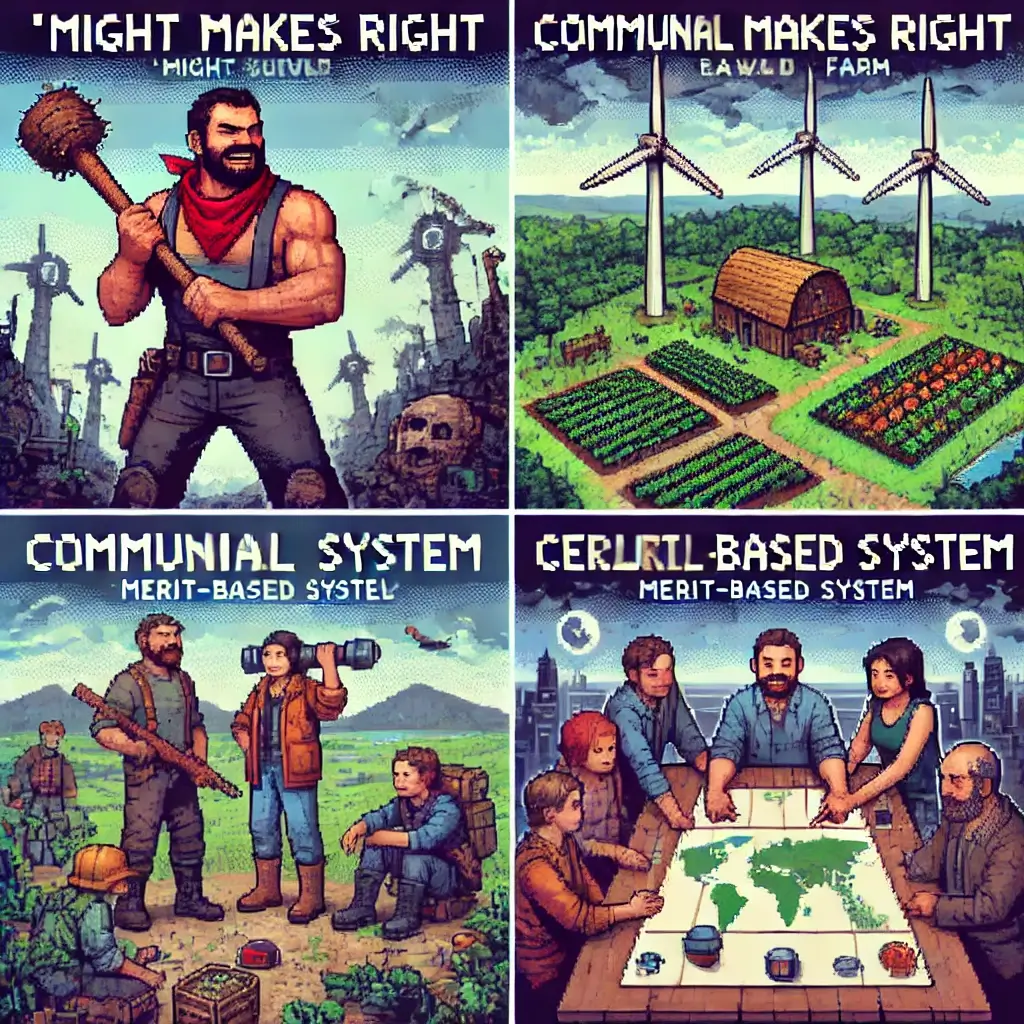
3 Apocalyptic Property Rights Models That Will Blow Your Mind!
Ever found yourself staring blankly at a wall, perhaps after binge-watching another season of your favorite post-apocalyptic show, and wondered, “What about the deeds?”
Yeah, I know, it’s not exactly the first thing that comes to mind when zombies are banging on your door or the power grid’s been down for three months.
Most folks are thinking about clean water, food, and maybe a sturdy blunt object.
But let’s be honest, even in a world gone sideways, humans are still, well, human.
And humans, bless their little hearts, love to argue about who owns what.
It’s practically in our DNA, right there next to the urge to hoard canned goods.
So, what happens to property rights when society crumbles like a stale cookie?
What happens to the fancy title deeds, the mortgages, the meticulously recorded property lines?
Do they just… poof? Vanish into the ether along with reliable internet and hot showers?
Today, we’re going to dive headfirst into that fascinating, slightly terrifying, and utterly crucial question.
We’re talking about hypothetical legal frameworks for land ownership and resource allocation after a societal collapse.
Forget your perfectly manicured lawns and HOA rules for a moment.
Imagine a world where the only “law” might be the biggest stick, or the most persuasive argument.
How do we rebuild something resembling order, especially when it comes to the very ground we stand on and the resources that keep us alive?
It’s not just some academic exercise, folks.
Understanding these potential frameworks can give us a powerful lens through which to view human nature, resilience, and the surprising ways we might try to claw our way back to civilization.
So, buckle up, grab your metaphorical emergency kit, and let’s explore three mind-bending models for property rights in the apocalypse! —
Table of Contents
—
Model 1: The “Might Makes Right” & First Possession Doctrine
Let’s start with the most primal, and perhaps most terrifying, option: “Might Makes Right.”
This isn’t really a “legal framework” in the traditional sense, is it?
It’s more like the absence of one, where brute force dictates ownership.
Think of it as the wild west on steroids, after the steroids have expired and everyone’s a bit… unhinged.
In this scenario, if you can take it, and you can hold it, it’s yours.
Simple, brutal, and utterly unsustainable in the long run.
But here’s where it gets interesting: even in such chaos, human beings, being creatures of habit and (sometimes) ingenuity, might gravitate towards something resembling the **First Possession Doctrine**.
What’s that, you ask? It’s basically the legal concept of “finders keepers, losers weepers,” but for land and resources.
Imagine a survivor stumbles upon an abandoned farm.
They clear the land, plant crops, maybe even fix the leaky roof.
Under a primitive First Possession system, their active labor and tangible investment in that property would grant them a form of legitimate claim.
It’s not about old deeds; it’s about present use and demonstrable effort.
Think about it: who’s going to argue with the person who’s actually tilling the soil and bringing in the harvest?
Sure, someone stronger *could* come along and take it, but that’s where the “Might Makes Right” part intersects.
This model, while seemingly chaotic, has a certain rough justice to it.
It incentivizes immediate action and resourcefulness.
If you need shelter, you go find it and make it habitable.
If you need food, you find land and cultivate it.
The problem, of course, is scale and stability.
How do you prevent constant conflict?
What happens when multiple groups lay claim to the same valuable resource, like a well or a fertile valley?
This is where things can quickly devolve into endless skirmishes, where the strong prey on the weak, and nobody has any true security.
The biggest challenge with “Might Makes Right” combined with First Possession is the lack of a higher authority to enforce these claims.
Without a rudimentary government, a militia, or even a respected elder council, any claim is only as good as the claimant’s ability to defend it.
It’s a model that might emerge organically in the immediate aftermath, but it’s a stepping stone, not a destination, if humanity hopes to rebuild anything sustainable.
Imagine trying to plan for next year’s crops when you don’t know if your neighbors will suddenly decide your field looks better than theirs.
Stressful, right? My blood pressure is rising just thinking about it!
Post-apocalyptic property rights, Scarcity, Survival, First possession, Anarchy —
Model 2: The Communal Stewardship Model
Now, let’s pivot to something a bit more… cozy, shall we?
The Communal Stewardship Model stands in stark contrast to the every-person-for-themselves ethos.
Here, the idea is that essential resources and, perhaps, all land, are held in common by a community.
No individual “owns” a piece of land in the traditional sense.
Instead, the community collectively manages and allocates resources for the benefit of all.
Think of it like a very large, very high-stakes co-op.
This model often emerges from necessity and a strong sense of mutual aid, especially after a catastrophic event where individual survival is nearly impossible without cooperation.
In a small, tight-knit community, say, a group of survivors holed up in an old school building or a fortified neighborhood, pooling resources makes perfect sense.
One person might be good at scavenging, another at farming, a third at medical aid.
Their collective efforts benefit everyone, and individual “ownership” of a plot of land or a retrieved cache of supplies becomes secondary to the group’s overall survival.
Under this framework, property rights aren’t about exclusive ownership but about usufruct – the right to use and enjoy the benefits of something, often with the duty to maintain it for future use.
So, you might be allocated a plot of land to farm, and the fruits of your labor are yours, but the land itself remains the community’s.
Perhaps decisions about major land use – where to build new shelters, where to expand farming, where to designate shared grazing areas – are made by a council, a consensus, or a charismatic leader.
The benefits are clear: reduced internal conflict over resources, a stronger sense of community, and the potential for greater efficiency in resource management (no wasted effort on duplicate tasks).
It fosters resilience and shared responsibility.
But, and there’s always a “but” with these things, this model faces its own set of challenges.
What about incentive?
If everything is shared, what motivates an individual to work harder, innovate, or take risks?
The “tragedy of the commons” is a very real concern here, where individuals might overuse or neglect shared resources because no one feels direct responsibility for them.
Also, scale is an issue.
This works beautifully in small groups where everyone knows everyone else, and social pressure can enforce norms.
But as communities grow, maintaining consensus and preventing freeloading becomes exponentially harder.
Think about your last group project in school – now imagine the stakes are literal survival.
The communal model, while offering a vision of cooperation and equality, demands high levels of trust, strong leadership (or incredibly effective democratic processes), and a shared ideology to truly thrive in the long term.
It’s the kind of dream scenario many idealists envision, but the practicalities can be a real headache.
Just ask any commune member from the 70s!
Post-apocalyptic society, Communal ownership, Resource sharing, Usufruct, Community survival —
Model 3: The Merit-Based & Contribution-Driven System
Alright, let’s get a bit more sophisticated, shall we?
The third model, the Merit-Based & Contribution-Driven System, tries to strike a balance between individual incentive and collective good.
It’s less about historical claims or raw strength, and more about what you can *do* for the nascent society.
In this framework, property rights – or at least, access to and preferential use of resources – are directly tied to an individual’s or group’s demonstrable contribution to the community’s survival and prosperity.
Imagine a community where specialists are highly valued.
The doctor who can heal the sick, the engineer who can get the old generator running, the farmer who consistently yields the most crops, the warrior who defends the perimeter – these individuals, and their households, might be granted more secure tenure over land, better access to shared tools, or a larger share of harvested resources.
It’s not pure capitalism, where wealth begets wealth, but a system where essential skills and hard work are the primary currency.
Property isn’t just “owned”; it’s earned through utility and effort.
For example, if you’re the only blacksmith in town, you might have exclusive rights to the forge and its tools, not because you “bought” them, but because you’re the one who can keep the community supplied with vital equipment.
Similarly, a group that successfully scavenges a difficult, dangerous area might be given preferential access to the bounty, or a larger share, as a reward for their risk and effort.
This model has some compelling advantages.
It directly incentivizes productivity, innovation, and specialization.
People are motivated to develop and apply useful skills, knowing that their efforts will translate into tangible benefits for themselves and their families.
It promotes a more dynamic and potentially more prosperous society than purely communal models, while avoiding the brutal instability of “might makes right.”
It could foster a sense of individual pride and accomplishment, crucial for morale in dire times.
However, the challenges are significant.
How do you objectively measure “merit” or “contribution?”
Who decides what skills are most valuable?
This system could easily lead to a new form of inequality, where those with essential skills become a new elite, potentially exploiting those with less immediately useful talents (e.g., artists, philosophers – tough luck in the initial apocalypse, my friends!).
What about those who are sick, injured, or elderly and can no longer contribute at the same level?
Does their “merit” from past contributions simply vanish?
Ensuring fairness and preventing the accumulation of disproportionate power in the hands of a few would require robust social mechanisms, perhaps a strong, impartial leadership or a system of checks and balances.
It’s a system that requires constant recalibration and a strong ethical compass from its leaders.
It’s like building an airplane mid-flight – thrilling, but fraught with peril.
Post-apocalyptic property rights, Merit-based system, Contribution, Resource allocation, Social order —
The Unwritten Rules of the Apocalypse: More Than Just Property
So, we’ve explored three vastly different approaches to property rights in a post-collapse world.
From the brutal efficiency of “finders keepers” to the hopeful unity of communal living, and the pragmatic incentivization of merit-based systems, each has its own set of pros and cons.
But here’s the kicker, folks:
No matter which system emerges, or which hybrid concoction of them takes root, the underlying principles will always be forged in the crucible of necessity and human nature.
It’s not just about who owns the land, but who controls the water, the medicine, the ammunition, and the knowledge.
These aren’t just legal debates; they’re discussions about survival, ethics, and the very essence of what it means to rebuild civilization from the ashes.
The rules of property, even when unwritten, are fundamentally about establishing order, minimizing conflict, and creating a basis for future prosperity.
They dictate who gets what, and why, and how disputes are settled when two survivors eye the same abandoned house or the last can of beans.
In a world without formal courts, judges, or police, these “laws” will be enforced by social pressure, community consensus, and, yes, sometimes by the willingness of a few good (or bad) people to back up their claims.
It’s messy, it’s dangerous, and it’s utterly fascinating.
The biggest lesson here?
That even when everything else falls apart, the human need for structure, for rules, and for some semblance of fairness, remains stubbornly persistent.
Because ultimately, without some agreement on who owns what, humanity’s greatest challenge won’t be zombies or radiation, but ourselves.
And that, my friends, is a thought more terrifying than any mutated monster.
Stay safe out there, and maybe, just maybe, start thinking about those property lines now.
You never know when you’ll need to draw a new map!
Post-apocalyptic governance, Societal rebuild, Ethical frameworks, Human nature, Conflict resolution —
Further Reading & Resources
For those of you who just can’t get enough of this slightly morbid yet utterly compelling topic, here are some fantastic resources that delve deeper into the legal, ethical, and practical challenges of societal collapse and the rebuilding of order:
Zoning Codes & Legal Structures Legal Twists in Reproductive Technology Digital Life: One Gigantic Mess? Genetic Ancestry Tests & DNA Data AR Privacy Nightmares & Your Data